Last week, every major U.S. stock index fell between 7.5% and 10% in five trading days. If you are still working and adding to your 401(k), that drop is mostly noise, and I wrote about why you should not let it change your plan in The Market Just Had a Terrible Week. Don't Let It Make Your Decisions.
If you are retired, or close to it, the same week reads differently. You are not adding money anymore. You are taking it out, and the bills, the property taxes, and the required minimum distributions (RMDs) do not wait for the market to recover. The question is not whether stocks come back. History says they usually do. The question is where your next year of living expenses comes from while they do.
That is what a bucket strategy answers, and the best time to set it up is a few years before you plan to retire, not the day you leave work.
What the Buckets Are
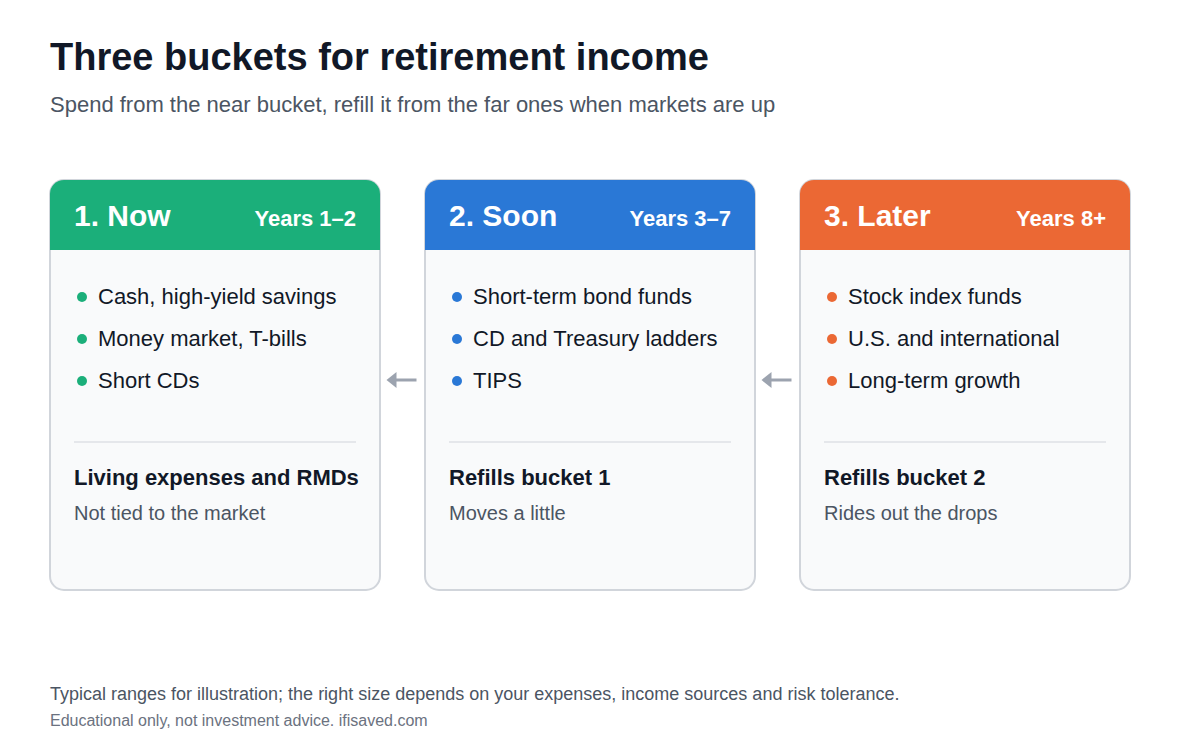
A bucket strategy splits your retirement savings by when you will spend it:
- Bucket 1, Now (about 1 to 2 years of spending): cash, high-yield savings, money market funds, Treasury bills, and short CDs. This is what you live on and where your RMDs come from. It does not go down when the stock market does.
- Bucket 2, Soon (about years 3 to 7): short-term bond funds, CD or Treasury ladders, and TIPS. It moves a little, and it refills bucket 1.
- Bucket 3, Later (year 8 and beyond): stock index funds for long-term growth. It has the time to ride out drops like last week's, and it refills bucket 2 after good years.
You size the buckets by your gap, not your total spending. If you spend $80,000 a year and Social Security or a pension covers $36,000, your portfolio has to cover $44,000. Two years of that is about $88,000 in bucket 1, and five more years is about $220,000 in bucket 2. Everything else can stay invested for the long run.
Why the Order of Returns Matters So Much
While you are saving, a bad year early on barely matters, because you are buying shares at lower prices. Once you start withdrawing, a bad year early on hurts much more, because you are selling shares at lower prices to pay the bills, and those shares are not there for the recovery. This is called sequence-of-returns risk.
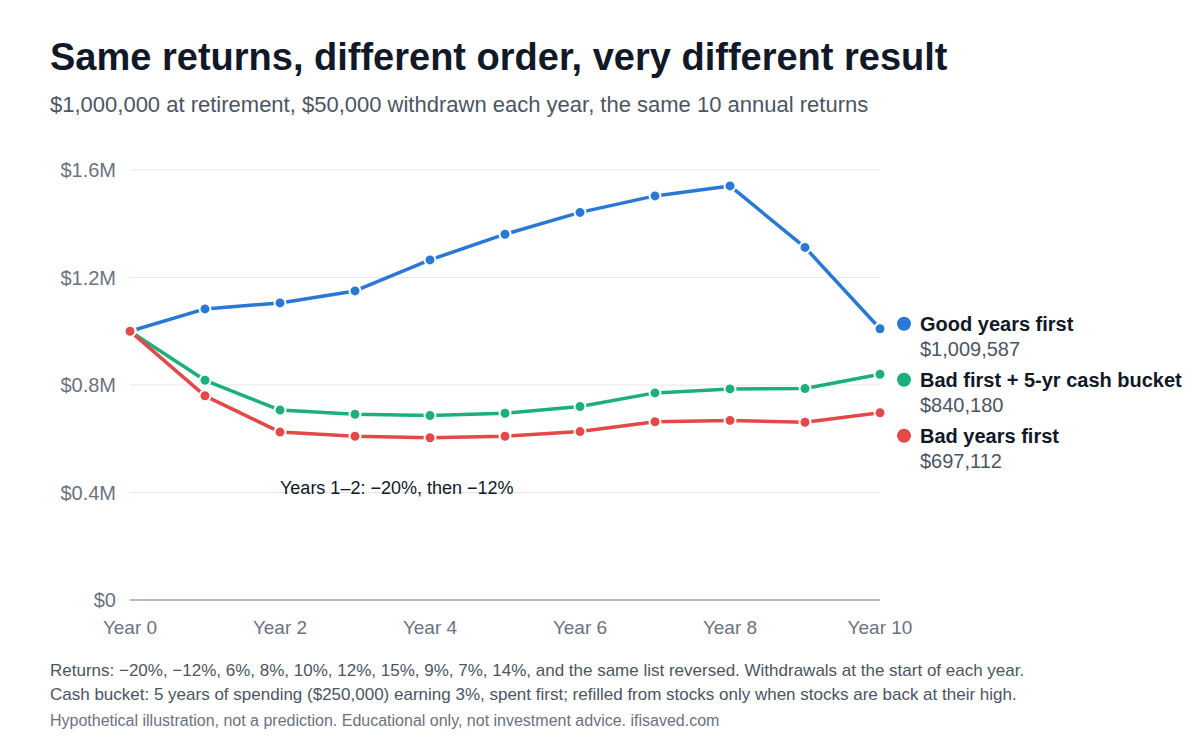
In this example, two retirees start with $1,000,000, withdraw $50,000 at the start of each year, and get exactly the same ten annual returns, just in opposite order. The one whose first two years are down 20% and 12% ends the decade with about $697,000. The one who gets the good years first ends with about $1,010,000. Same average return, a difference of more than $300,000, and the only thing that changed was the timing of the bad years.
Buckets do not change the returns. What they change is what you sell in a bad year. The green line is the same unlucky retiree, with the same returns in the same order, except that $250,000 (five years of spending) sits in cash and short-term holdings earning 3%. They live on that money for the first six years, while stocks fall and then recover, and only refill it from stocks once stocks are back at their high. Instead of selling stock funds 20% and 30% below where they started, they leave those shares alone for the recovery, and they end the decade at about $840,000 instead of $697,000. That''s about $143,000 more, from the same market.
Why Before Your Retirement Date, Not On It
Most people plan to retire at a particular age. A lot of people do not get to choose. In the Employee Benefit Research Institute's Retirement Confidence Survey, close to half of retirees say they retired earlier than they planned, most often because of a health problem, a layoff or company change, or caring for a family member.
If your buckets are scheduled to be filled at 65 and you are suddenly retired at 62, you have two problems at once:
- You need income sooner and for longer. Three extra years of spending, often before Social Security, and health insurance before Medicare at 65.
- You may have to build the buckets at a bad time. Filling bucket 1 means selling investments. If that happens the month after a drop like last week's, you lock in the loss on exactly the money you were trying to protect.
Building the buckets gradually over the last two to five years of work fixes both. You can move money from stocks into cash and bonds after good years, when prices are high, instead of all at once on a schedule the market does not care about. And if your retirement date moves up, the money is already in place.
The Lesson From 2008 and 2022
- 2008: the S&P 500 fell about 57% from its October 2007 peak to its March 2009 bottom, and did not get back to that peak until March 2013, about five and a half years later. That is why bucket 2 covers years 3 to 7. A retiree with seven years of spending outside of stocks never had to sell a share at the bottom.
- 2022: stocks fell about 18% for the year, and the broad U.S. bond market fell about 13%, its worst year on record. Long-term bonds did not protect anyone that year. That is why bucket 1 is cash and short-term holdings, not just "bonds".
Don't Forget RMDs
Once you reach RMD age (73 if you were born from 1951 through 1959, and 75 if you were born in 1960 or later), you have to take a minimum amount out of your traditional IRAs and 401(k)s every year, whether the market is up or down. Miss it and the IRS penalty is 25% of the amount you should have taken (10% if you fix it in time).
Two things make RMDs especially tough after a drop:
- The amount is set by last year's balance. Your 2026 RMD is based on your account value on December 31, 2025. If your IRA was $500,000 then and you are 73, your RMD is about $18,868 (using the IRS divisor of 26.5). If your account is down 10% to $450,000 when you take it, that same RMD is now 4.2% of what is left instead of 3.8%.
- The deadline is December 31. If you have not taken your 2026 RMD yet, you still have to take it in the next few weeks, right after the drop. (The only exception is your very first RMD, which you can delay until April 1 of the next year.)
This is where people get caught: their cash bucket is in a bank account, but the RMD has to come out of the IRA. Keep part of bucket 1 inside the IRA (a money market fund or short Treasuries held in the account), so you can take the RMD from that instead of selling stock funds after a drop. Other options worth knowing:
- Take the RMD "in kind." You can move shares from the IRA to a taxable brokerage account instead of selling them. It still counts as your RMD and is taxed at the value on the day it moves, but you stay invested for the recovery.
- Give it away. If you are 70½ or older and give to charity, a qualified charitable distribution (QCD) sent directly from your IRA counts toward your RMD and is not added to your taxable income.
What Buckets Are Not
To be fair about it: buckets do not make your money grow faster. Cash and bonds usually earn less than stocks over time, so a big bucket 1 has a cost. Run the same example with the good years first, and the retiree with the five-year bucket ends at about $943,000 instead of $1,010,000, because that $250,000 earned 3% while stocks were climbing. Think of it as insurance: you pay a little in good markets so you are not forced to sell in bad ones. And on paper, a bucket strategy is really just an asset allocation with labels on it. The value is practical: you know exactly where next year''s spending comes from, you are never forced to sell stocks in a bad month, and it is a lot easier to leave the long-term money alone in a week like last week when you know your bills are already covered.
How to Set Your Buckets in IfISaved
- Find your gap. Use Budgets to see what you actually spend in a year, then subtract Social Security and any pension.
- Pick your cash level. The Risk Gradient analysis on the Retirement Planning page asks how many years of expenses you want in cash-equivalent reserves, and the Asset Allocation analysis shows how your current portfolio compares to that target.
- Track bucket 1 and 2 holdings. CDs and high-yield savings live on the Special Savings tab of the Investments page, next to your brokerage and retirement accounts.
- Test an earlier date. Run the Monte Carlo analysis with your planned retirement age, then two or three years earlier, and look at the Early Retirement Bridge and healthcare analyses for the years before 59½ and 65. If the earlier date is the one that worries you, that is your cue to start filling the buckets now. For more on bridging to 59½, see The Rule of 72: Bridging the Gap to Age 59½.
The market will drop again, probably more than once during your retirement. You cannot control when. You can control whether, when it happens, your next two years of living expenses are already sitting somewhere the market cannot reach.
This article is for educational purposes only and is not financial, tax, or investment advice. The sequence-of-returns example is hypothetical and is not a prediction. Index and bond-market figures are approximate price and total-return figures from public market data; you cannot invest directly in an index. RMD rules and ages are summarized from current IRS guidance and can change. Consider speaking with a qualified financial or tax professional about your situation.