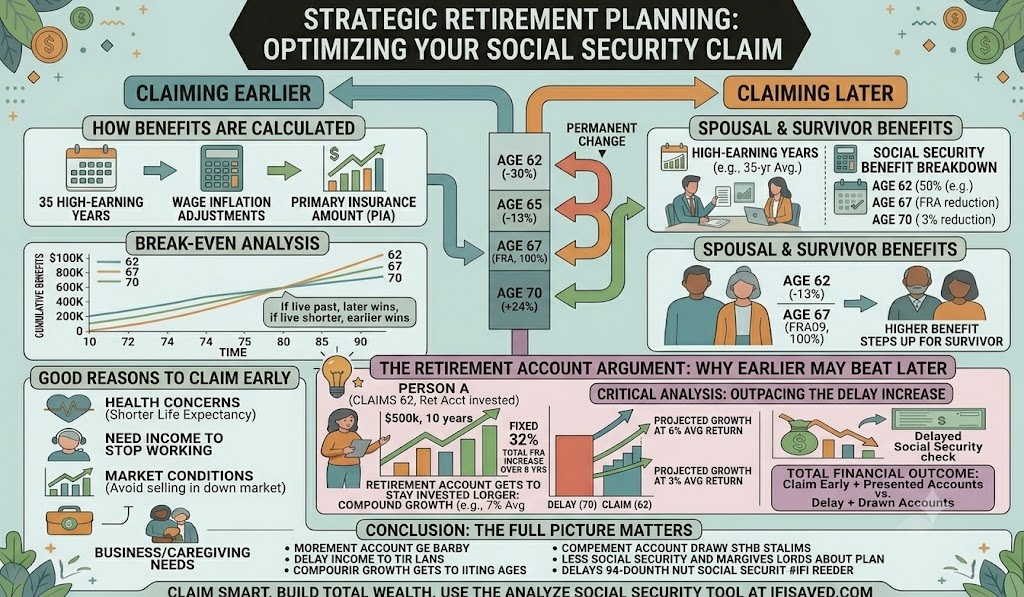
Few retirement decisions carry as much weight — or generate as much debate — as when to start collecting Social Security. The answer depends on your health, your other income sources, your spouse's situation, and a factor most people overlook: what your retirement accounts will do while you wait. The Analyze Social Security page on IfISaved is built to help you model all of these trade-offs visually before you commit to anything.
How Benefits Are Calculated
The SSA bases your benefit on your 35 highest-earning years, adjusted for wage inflation over your career. From that average, it applies a graduated formula to produce your Primary Insurance Amount (PIA) — the monthly check you receive if you claim at exactly your Full Retirement Age (FRA). For anyone born in 1960 or later, FRA is 67.
Every year you claim before FRA, your monthly benefit is permanently reduced. Every year you wait past FRA (up to age 70), it is permanently increased. The four standard checkpoints are:
- Age 62 — Earliest possible. Monthly benefit is reduced by approximately 30% compared to FRA.
- Age 65 — A common emotional target, but not the break-even sweet spot people assume. Benefit is still roughly 13% below FRA.
- Age 67 (FRA) — You receive 100% of your PIA. No reductions, no bonus.
- Age 70 — Maximum benefit. You receive 124% of your PIA. There is no incentive to wait past 70.
The Break-Even Analysis
The most common argument for delaying Social Security goes like this: if you wait until 70 instead of claiming at 62, your monthly check is roughly 77% larger. Sounds compelling — until you account for all the checks you did not receive during those eight years.
The Analyze Social Security page plots cumulative lifetime benefits for each claiming age from 62 all the way to your expected life expectancy. The lines cross — that is the break-even age. For most people comparing age 62 to age 70, the break-even falls somewhere in their late 70s to early 80s. If you live past that age, waiting paid off. If you do not, claiming early was the better financial move.
Of course, nobody knows exactly how long they will live. But the chart gives you an honest look at the math instead of relying on rules of thumb.
Spousal Benefits
The analyzer also supports spousal benefit calculations. A spouse who earned less — or nothing — during their career can claim up to 50% of their partner's PIA at FRA, or a reduced amount if they claim earlier. When one spouse delays to 70 and passes away first, the surviving spouse steps up to the higher benefit for the rest of their life. This survivor benefit angle often tips the scales toward having at least one spouse delay as long as reasonably possible.
You can enter earnings histories for both yourself and your spouse, choose separate claiming ages for each, and compare the combined lifetime income under multiple scenarios — all on the same page.
Good Reasons to Claim Early
Delaying Social Security is not automatically the smart move. There are legitimate, financially sound reasons to start collecting at 62 or 65:
- Health concerns. If you have reason to believe your life expectancy is shorter than average, collecting earlier captures more total lifetime benefit before the break-even point is reached.
- You need the income to stop working. If claiming at 62 allows you to leave a physically demanding job and preserve your health, that quality-of-life benefit can outweigh the reduced check.
- Market conditions. If you would otherwise be forced to sell investments in a down market to pay living expenses, starting Social Security keeps you from locking in losses.
- Business or caregiving needs. Some people have better uses for their time and energy in their early 60s than extending a career or waiting on a larger monthly benefit.
The Retirement Account Argument — Why Earlier May Beat Later
Here is the angle that does not get enough attention: when you take Social Security early, your retirement accounts get to stay invested longer.
Consider two people retiring at 62 with $500,000 in a 401(k). Person A claims Social Security immediately and uses it to cover most of their living expenses. Their retirement account makes small, controlled withdrawals — or none at all — for years. Person B delays Social Security to 70, which means they must draw down the 401(k) heavily for eight years to bridge the gap.
Person B will eventually receive a larger monthly Social Security check. But Person A's retirement account — left largely intact during those eight years — has been compounding the entire time. At an average return of 7%, $500,000 nearly doubles over a decade. That growth does not show up in a simple Social Security break-even calculation, but it is very real money.
Even if the Social Security income is being used for ordinary daily expenses like groceries, utilities, and car payments, it is performing an important function: it is substituting for money that would otherwise have to come out of your retirement accounts. Every dollar Social Security covers is a dollar that stays invested, earns a return, and compounds. Over time, the retirement account that was left alone can produce far more total wealth than the lifetime gain from a delayed Social Security benefit.
Conclusion: The Full Picture Matters
The conventional wisdom — wait until 70 for the biggest check — is a reasonable starting point, but it is not the whole story. For many people, particularly those with meaningful retirement savings, claiming Social Security earlier and preserving retirement account balances can produce better total financial outcomes than waiting for the maximum benefit at 65 or 70.
The money you leave in a 401(k) or IRA does not sit still. It works. It compounds. And unlike the fixed monthly increase you gain by delaying Social Security, the growth from a well-invested retirement account has no ceiling.
Use the Analyze Social Security page on IfISaved to enter your own numbers and life expectancy, compare every claiming age side by side, and see the break-even crossover for yourself. Then look at it alongside your retirement account projections on the Retirement Planning page. The right answer is the one that makes sense for your complete financial picture — not just one line item in isolation.