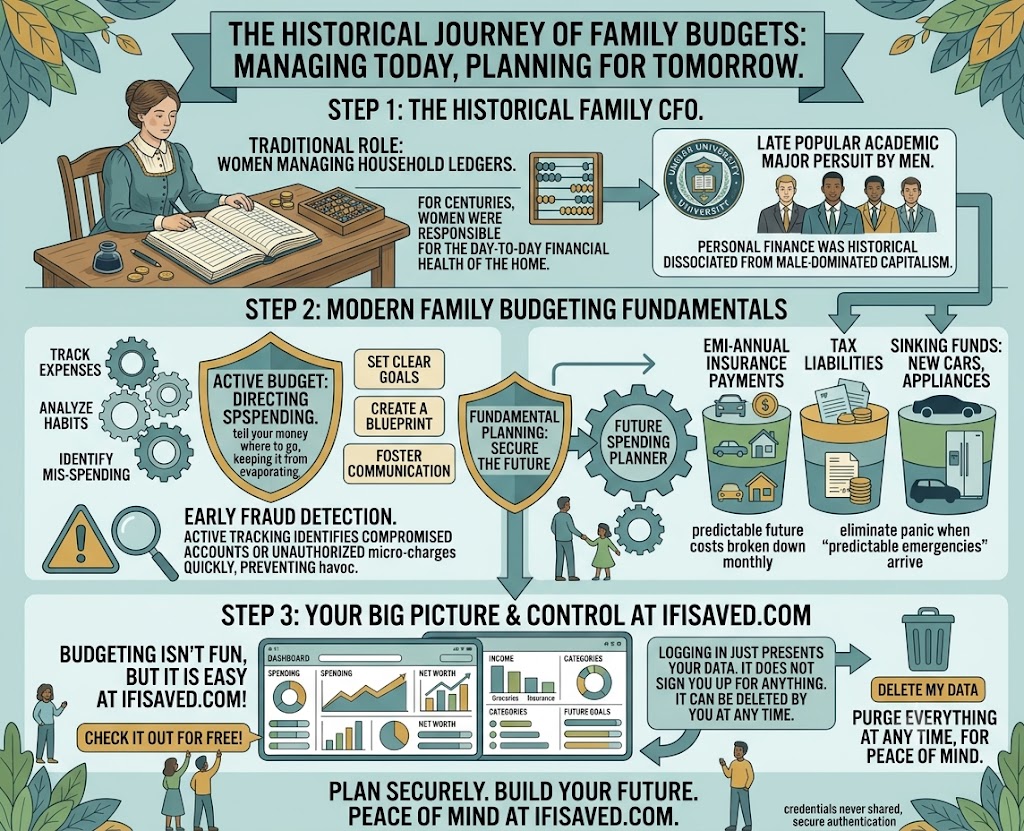
When you think about the history of personal finance, it’s easy to imagine a legacy dominated entirely by men in corporate offices. But if you zoom in on the history of the household, a completely different picture emerges. For centuries, the day-to-day management of family finances didn’t fall to the "breadwinner"—it was almost entirely the domain of women.
The Historical Legacy of the Household CFO
Historically, the family was the core economic unit of society. While men often labored in the fields, factories, or trades, women were the operational managers of the home. According to historical accounts documented by researchers on the evolution of domestic economics (such as the analysis of pre-industrial and 19th-century households on AskHistorians), women were expected to balance account ledgers, negotiate with local tradesmen, and distribute resources. Classic 19th-century guides like Lydia Maria Child’s The American Frugal Housewife were written explicitly for women, advising them to keep an exact account of every single expenditure.
Because domestic household budgeting and ledger-keeping were historically labeled as "home economics" or "women’s work," personal finance was broadly dissociated from corporate capitalism. This cultural divide explains why personal finance and financial planning were rarely pursued by men as popular academic majors until recent decades. It wasn't until the institutional shift toward modern corporate financial advising, combined with major legislative milestones like the Equal Credit Opportunity Act of 1974, that personal finance truly merged with mainstream academic and professional career paths for everyone.
Directing and Controlling the Flow of Money
The core lesson from our historical counterparts remains identical today: a family budget is the most critical tool you have for directing your spending and keeping it under control. Without a deliberate plan, money has a habit of evaporating. A budget isn’t a restriction on your freedom; it’s an active blueprint. It gives you the authority to tell your money where to go at the beginning of the month, rather than wondering where it went at the end.
Planning for the Non-Monthly Future
Where most modern budgets break down isn’t the daily routine—it’s the predictable surprises. We easily remember our monthly rent or streaming subscriptions, but we frequently fail to plan for the irregular expenses waiting over the horizon. True financial security requires accounting for non-monthly spending before it arrives:
- Semi-annual payments: Auto and home insurance premiums that arrive every six months.
- Tax liabilities: Annual property taxes or seasonal tax preparation fees.
- Sinking funds: Saving gradually for the day your current car needs to be replaced or your home needs a new appliance.
By breaking these massive, future expenses down into smaller monthly chunks, you eliminate the panic of "emergency" bills that were completely predictable from the start.
The Hidden Defense: Spotting Fraud Early
Budgeting provides a secondary benefit that is more critical today than ever: financial defense. When you actively track your daily and weekly expenses, you build a sharp awareness of your account activity. If a compromised card results in a fraudulent micro-charge or an unauthorized subscription, you will notice it immediately. Catching identity theft or banking errors early prevents them from snowballing into catastrophic disruptions that can wreck havoc on your credit score and stress levels.
Budgeting Made Easy (And Free)
Let’s be honest: tracking numbers and anticipating insurance bills might not sound like a fun weekend hobby. But it doesn’t have to be a chore. At IfISaved, we believe that while budgeting isn’t inherently fun, it can absolutely be made easy.
We invite you to experience our completely free Budget Planner. When you create an account, logging in doesn’t sign you up for spam, newsletters, or hidden obligations—it simply helps us securely present and store your financial data so it’s waiting for you whenever you return. Best of all, you remain in complete control of your information; your account and its data can be permanently deleted by you at any time. Take control of your financial story and check it out today!