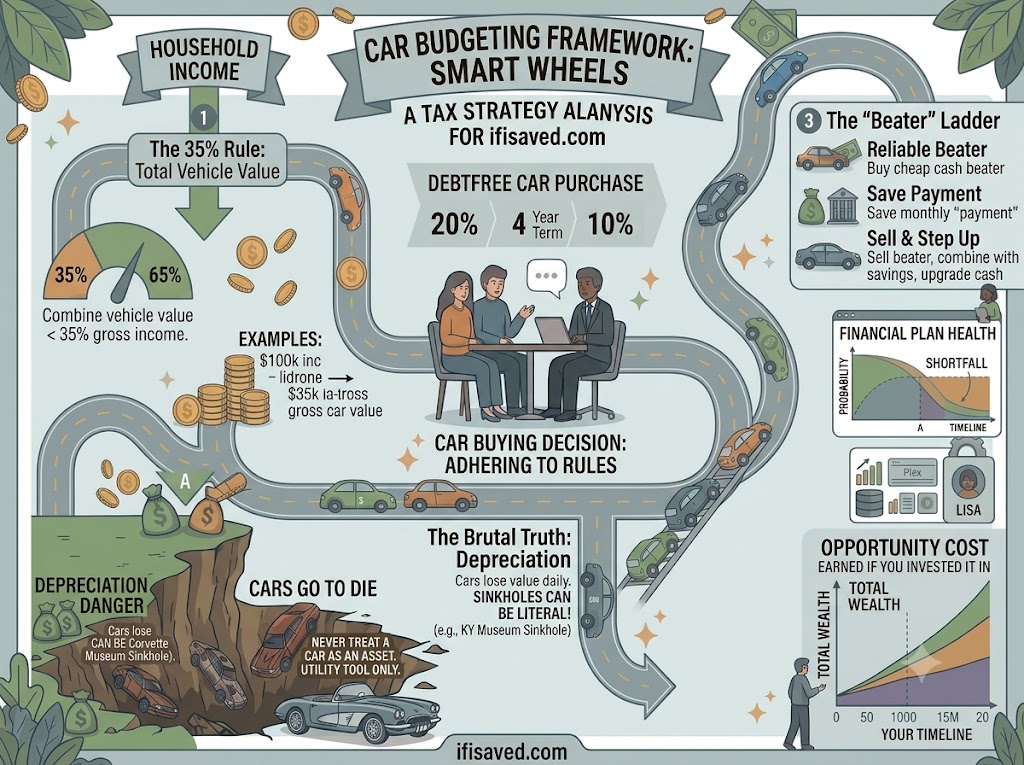
1. The 35% Rule: Total Vehicle Value
Before looking at monthly payments, look at the big picture. The total combined value of all the vehicles in your household should never exceed 35% of your gross annual household income.
- If your household earns $100,000 a year, the combined current market value of all your family cars should top out at $35,000.
- If you earn $60,000, your limit is $21,000.
Why? Because cars are rapidly depreciating assets. Allocating too much of your net worth into things that go down in value actively steals from your ability to invest in things that go up in value.
2. The Financing Guardrails: The 20/4/10 Rule
If you absolutely must finance your next vehicle, do not let the dealership dictate the terms. Protect your monthly cash flow by sticking strictly to the 20/4/10 rule:
- 20% Down: Put at least 20% down in cash. This keeps you from immediately going "underwater" (owing more than the car is worth) the moment you drive off the lot.
- 4 Years Maximum: Limit your loan term to no more than 4 years (48 months). Longer loan terms are just a trap to lower your monthly payment while costing you thousands more in interest.
- 10% Monthly Limit: Your total monthly vehicle costs—which must include your loan payment, fuel, and insurance—should not exceed 10% of your gross monthly income.
3. The "Beater" Ladder: Driving Your Way to a Cash Car
The ultimate goal is to completely eliminate car payments from your life. The most effective way to do this is to climb the "beater ladder":
- Buy a reliable beater: Buy a cheap, highly reliable older car (like an older Honda or Toyota) with cash.
- Save your "payment": While driving this car without a monthly payment, actively save the money you would have spent on a car loan into a dedicated savings account.
- Sell and step up: Older used cars depreciate very slowly. When you've saved up a few thousand dollars, sell the beater for close to what you paid for it, combine that cash with your savings, and upgrade to a slightly better, more reliable vehicle.
By repeating this process, you can step up to a high-quality, highly reliable vehicle completely debt-free.
4. The Brutal Truth of Depreciation (and Sinkholes)
Always remember: cars are machines, not investments. They rust, they break, and they lose value every single day. Even the most "priceless" collectibles are subject to physical reality.
Look no further than the infamous 2014 National Corvette Museum sinkhole in Kentucky. In an instant, a massive sinkhole opened up beneath the museum floor, swallowing eight extremely rare and priceless historic Corvettes into the earth.
If physical sinkholes can destroy museum-grade vehicles in seconds, normal wear and tear, accidents, and daily commutes will certainly deplete the value of your daily driver. Never treat a car as an asset—it is a utility tool that gets you from point A to point B.
Conclusion: Don't Be Car Poor
At the end of the day, you want to avoid being "car poor"—trapped in a cycle where your hard-earned income is entirely spoken for by heavy monthly payments and expensive vehicle maintenance.
Keep your transportation numbers tightly under control. By freeing up your monthly cash flow, you stop living paycheck to paycheck and give yourself the financial margin to invest in your retirement, build real wealth, and actually enjoy life.