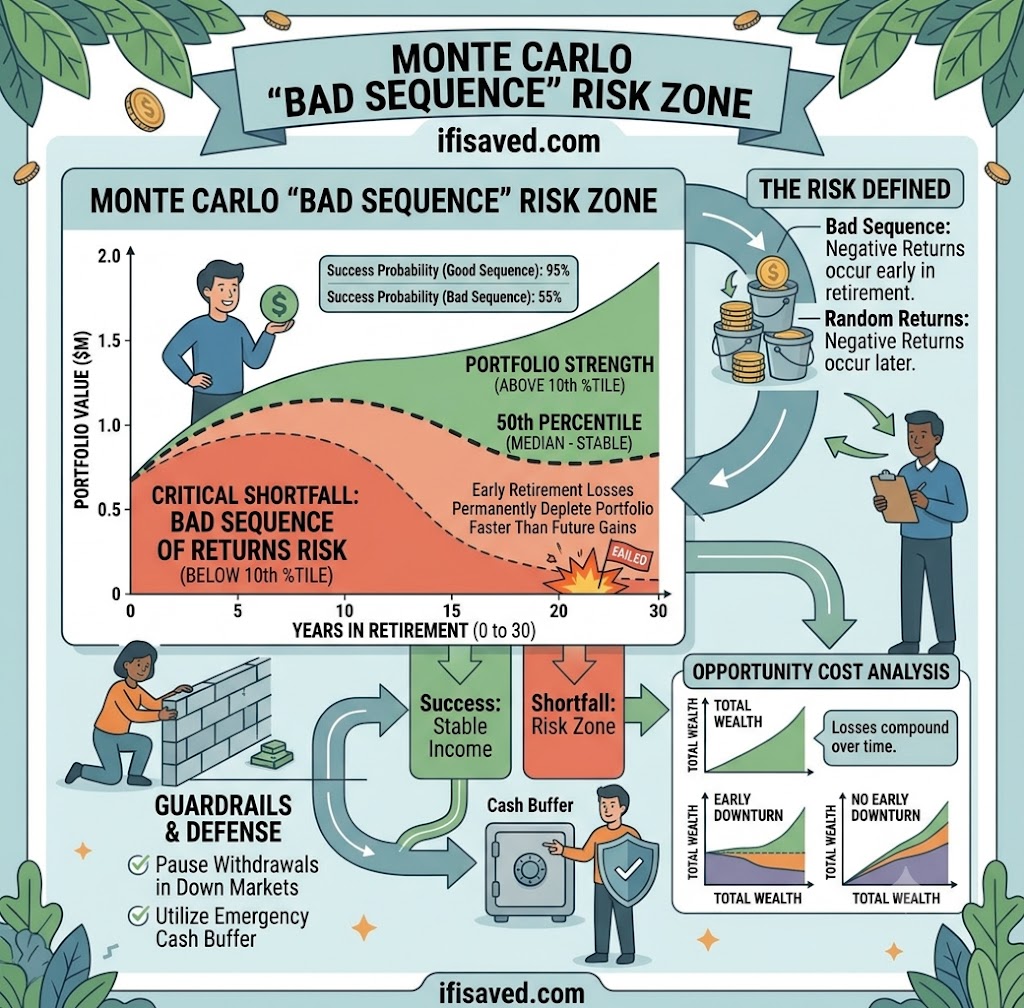
When you are accumulating wealth, your average annual return is what matters most. But once you enter retirement and begin withdrawing funds, the timing of those returns becomes critical. This is known as Sequence of Returns Risk.
What is Sequence of Returns Risk?
Sequence of returns risk is the danger that a major market downturn occurs early in your retirement, just as you begin making withdrawals. Because you are forced to sell assets to generate income, selling during a market crash means locking in those losses permanently. Your remaining portfolio then has less capital to recover when the market eventually turns around, which can significantly shorten the longevity of your retirement savings.
Strategies to Mitigate Risk
Guard Rails Approach
This strategy involves adjusting your annual withdrawal percentage based on market performance—reducing spending when markets are down and increasing when they are up.
- Pros: Significantly reduces the probability of portfolio depletion; provides a disciplined framework for lifestyle adjustments.
- Cons: Requires flexibility in your retirement budget; can lead to significant reductions in lifestyle spending during extended bear markets.
Annuities
Annuities provide a guaranteed stream of income regardless of market conditions, essentially shifting the risk to an insurance company.
- Pros: Provides "pension-like" security that is not tied to market volatility; removes the stress of managing investments for income.
- Cons:
- High Costs & Fees: Complex fee structures—including mortality and expense charges—can erode net returns.
- Opportunity Cost: You lose the growth potential of a market-invested portfolio, often capping your upside.
- Inheritance Risk: Many are "life-only," meaning if you die early, the insurance company keeps the balance, and your beneficiaries lose out on a potential inheritance.
- Lack of Liquidity: Capital is often locked away with steep surrender charges.
Part-Time Income
Working during the early years of retirement allows you to defer withdrawals from your portfolio.
- Pros: Reduces the amount needed from your portfolio, allowing investments to compound longer; provides social engagement.
- Cons: Limits your retirement freedom; health or job market conditions may make sustaining this income difficult.
Bucket Strategy
Segmenting assets into time-based "buckets" (e.g., cash for years 1–2, bonds for 3–7, equities for 8+).
- Pros: Psychologically comforting; prevents you from selling equities during a downturn because your immediate spending needs are met by cash/bonds.
- Cons: Can lead to "cash drag" where too much money sits in low-interest accounts; requires active management to keep buckets filled.
Balanced Portfolio
Holding a strategic mix of stocks and bonds to dampen volatility.
- Pros: Simple to implement; bonds act as a shock absorber during equity market crashes.
- Cons: Requires consistent rebalancing; during long equity bull markets, you may trail the returns of a 100% stock portfolio.
Managing the Balanced Portfolio & Long-Term Solvency
If you use a balanced portfolio, the key to solvency is disciplined rebalancing. When the market recovers, you should use excess returns from your equity holdings to "replenish" your bond or cash reserves. By selling high after a recovery, you stabilize your safety net, ensuring you are prepared for the next inevitable downturn without ever being forced to liquidate equities at a loss.
The Verdict
While every strategy has merits, the Bucket Strategy or a Balanced Investment Portfolio remains the superior choice for most retirees. These methods provide the best balance of flexibility, liquidity, and cost-efficiency, allowing you to control your assets while managing volatility effectively.
Are You On Track?
Understanding these risks is only the first step. You need to see how your specific savings plan holds up against potential market volatility. Visit the Retirements page on ifisaved.com to model your unique scenario and check your retirement readiness today.