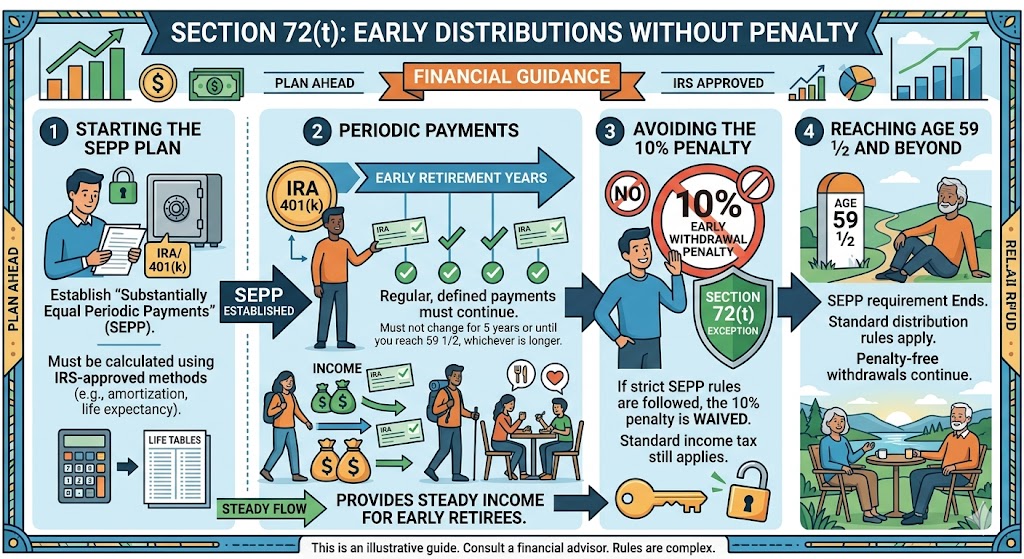
One of the most exciting — and underestimated — questions in personal finance is: What happens between the day you retire early and the day you turn 59½? That gap can be five years, fifteen years, or more. Plan it well and you have total financial freedom. Plan it poorly and you face a 10% IRS penalty every time you touch your own retirement money. The IRSs does give you some flexibility if you decide you are done earlier than 59½ and want to access your tax advantaged accounts, Section 72(t).
IRS Section 72(t): The Rule That Unlocks Your Retirement Accounts Early
While the mathematical Rule of 72 helps you think about growth, IRS Section 72(t) is the legal mechanism that lets you access money inside your IRA or rollover IRA before age 59½ without paying the normal 10% early withdrawal penalty. The strategy is called a Substantially Equal Periodic Payment (SEPP) program — sometimes called a "72(t) distribution."
The IRS allows three calculation methods to determine your annual payment amount:
- Required Minimum Distribution (RMD) Method — Divides your account balance by a life-expectancy factor from IRS tables each year. Payments vary year to year. This typically produces the lowest payment.
- Fixed Amortization Method — Amortizes your account balance over your remaining life expectancy at a reasonable interest rate. Payments are fixed for the life of the program.
- Fixed Annuitization Method — Similar to amortization but uses an annuity factor from IRS tables. Also produces fixed payments.
The IRS details these rules in IRS.gov — Substantially Equal Periodic Payments and in Revenue Ruling 2022-24, which updated the applicable interest rates and life-expectancy tables used in the calculations.
The Critical Rules You Must Follow with 72(t)
A 72(t) program is not something to enter casually. The rules are strict and the consequences of a mistake are severe. Here is what you must know:
- Commit to the longer of five years or until you reach 59½. If you start at age 52, you must continue until you turn 59½ — that is 7½ years. If you start at age 57, you must continue for 5 full years — until you are 62. This is the rule that surprises most people.
- Do not modify or stop the payments early. If you break the schedule for any reason — even skipping one payment — the IRS treats the entire series of distributions as non-qualifying. You will owe the 10% penalty on every dollar you already received, plus interest. This is a catastrophic mistake that can wipe out years of savings.
- Segregate the account. The 72(t) rules apply to a specific account. If you want to take SEPP distributions from only a portion of your IRA, you should split that IRA into two accounts first: one for the 72(t) program and one you leave untouched. You cannot make contributions to the SEPP account while the program is active.
- One allowed change. You are permitted a one-time switch from the fixed amortization or fixed annuitization method to the RMD method. This can be useful if the account has lost significant value and your fixed payment is drawing it down too quickly.
- Taxes still apply. The 72(t) exception only waives the 10% early withdrawal penalty. You still owe ordinary income tax on distributions from pre-tax accounts. Plan your annual withdrawals with your marginal tax rate in mind.
- Roth IRA contributions are different. Your contributions to a Roth IRA can always be withdrawn at any time, tax- and penalty-free — no 72(t) needed. Only the earnings are restricted before 59½. This is a key reason why building Roth accounts early gives you so much flexibility.
Investopedia has a thorough treatment of 72(t) mechanics and traps at Investopedia — Rule of 72(t).
The Bridge Brokerage Account: Your Most Flexible Tool
For most early retirees, the best first line of defense in the gap years is a plain taxable brokerage account — sometimes called a "gap account" or "bridge account." There are no contribution limits, no withdrawal restrictions, and no penalty for accessing the money at any age. Long-term capital gains rates (0%, 15%, or 20% depending on your income) are often lower than your ordinary income rate anyway, making a brokerage account surprisingly tax-efficient.
The strategy is simple: in the years before you retire early, max out your tax-advantaged accounts first (401k match, HSA, Roth IRA), then direct everything extra into this taxable bridge account. Index funds, ETFs, and dividend-payers are all common choices here. The Rule of 72 works in your favor — money you put in at 40 can double before you even need it at 50 or 55.
NerdWallet covers the bridge account concept as part of early retirement planning at NerdWallet — How to Bridge the Gap to Retirement.
The Rule of 55: Another Early Access Option
If you leave your employer in or after the calendar year you turn 55 (age 50 for certain public safety employees), the IRS allows you to take withdrawals from that employer's 401(k) plan — and only that plan — without the 10% penalty. This is a simpler and less risky alternative to 72(t) for people who retire in their mid-to-late 50s. You still owe income tax, and you lose the option if you roll that 401(k) into an IRA before you need the money, so timing matters. IRS details are at IRS — Retirement Topics: Tax on Early Distributions and Investopedia covers it at Investopedia — Rule of 55.
Roth Conversions: Turning the Gap Years Into a Tax Advantage
Early retirement gap years are often the lowest-income years of your adult life — and that is actually a tremendous opportunity if you are heavily weighted in tax-deferred accounts like a traditional 401(k) or traditional IRA. When your taxable income is low, the cost of converting those pre-tax dollars to a Roth IRA is minimized.
A Roth conversion means you move money from a traditional IRA (or rollover IRA) into a Roth IRA, paying ordinary income tax on the converted amount in that year. Once in the Roth, that money grows tax-free and — after it has been in the Roth at least five years and you are 59½ — every dollar comes out tax-free forever, with no required minimum distributions.
Here is a practical example: Suppose you retire at 52 with $800,000 in a traditional IRA and $100,000 in a bridge brokerage account. Your gap-year income is low. You might convert $30,000–$50,000 per year from your traditional IRA to a Roth, staying within the 12% or 22% federal tax bracket. You pay the tax from your bridge account — not from the converted amount — so the full conversion lands in the Roth and starts growing tax-free immediately.
Key rules to remember with Roth conversions:
- Five-year rule on each conversion. Each converted amount has its own five-year clock for the 10% early-withdrawal penalty on that principal (not on the tax-free earnings rule, which requires both the account to be 5 years old and you to be 59½). If you convert in year one of retirement and withdraw that converted principal in year three, you owe the 10% penalty. Plan your conversion ladder so that early conversions are available when you need them.
- ACA premium tax credits. If you are buying health insurance on the marketplace during your gap years, income from Roth conversions counts as MAGI and can reduce or eliminate your premium tax credits. Model your conversions against your expected subsidy to find the optimal amount each year. The Kaiser Family Foundation has a useful calculator at KFF — Health Insurance Marketplace Calculator.
- Pay tax from outside funds. If you pay the tax bill using money from the converted amount itself (by withholding from the conversion), you have effectively taken an early distribution of that withheld portion — potentially triggering the 10% penalty. Pay conversion taxes from your bridge account instead.
- IRMAA for Medicare. If your conversions push income high in the years just before you turn 65, you could trigger Medicare Income-Related Monthly Adjustment Amounts (IRMAA), which raise your Part B and Part D premiums. Look two years ahead when planning large conversions.
Fidelity has an excellent overview of Roth conversion strategy at Fidelity — Is a Roth Conversion Right for You? and Vanguard covers the mechanics at Vanguard — Roth IRA Conversion.
The Roth Conversion Ladder: A Systematic Bridge Strategy
If you want to replace your 72(t) distributions with Roth money but do not want to touch your Roth earnings before 59½, the Roth conversion ladder is the answer. The mechanics work like this:
- Each year of your gap, convert a chunk of your traditional IRA to Roth. You pay income tax that year.
- Five years later, those converted dollars are available to withdraw from the Roth completely penalty-free (as converted principal, independent of your age).
- By starting the ladder early enough — ideally five or more years before you need the money — you create a rolling stream of penalty-free Roth principal that replaces your bridge brokerage as it depletes.
This strategy works best if you start it at least five years before your bridge account runs out. If you retire at 45, start converting at 50 and your converted principal from year one is available penalty-free at 55. Investopedia covers the ladder strategy in detail at Investopedia — How a Roth IRA Conversion Ladder Works.
What If You Go Back to Work?
One of the underappreciated aspects of an early retirement bridge plan is its flexibility in the other direction. Life changes — a compelling opportunity, a health insurance need, a passion project that generates income. If you return to work during your gap years, you have options that can actually accelerate your position:
- Roth 401(k) contributions. If your new employer offers a Roth 401(k), earned income lets you contribute up to the annual 401(k) limit ($23,500 in 2026, plus $7,500 catch-up if you are 50 or older) with post-tax dollars that will grow and be distributed tax-free. This is an extraordinary opportunity if your gap-year income puts you in a lower bracket than your peak working years. The money compounds tax-free and bypasses the 5-year Roth IRA contribution rules since qualified distributions from a Roth 401(k) follow 401(k) rules.
- Bridge brokerage refueling. Part-time or contract income during the gap years can be directed straight into your taxable bridge account, extending the runway without disturbing your Roth conversion ladder or your 72(t) program.
- Roth IRA contributions. As long as you have earned income, you can still contribute to a Roth IRA up to the annual limit ($7,000 in 2026, plus $1,000 catch-up if 50+), subject to income limits. Even a part-time consulting engagement can justify a full prior-year Roth contribution.
- Pause your conversion ladder if income rises. If returning to work pushes your income into a higher bracket, consider pausing or reducing Roth conversions in high-income years and resuming when your income drops again. There is no requirement to convert on a fixed schedule.
IRS contribution limits and eligibility rules for all account types are updated annually at IRS — Retirement Topics: IRA Contribution Limits and IRS — 401(k) Limit and IRA Contribution Announcements.
Putting It All Together
An effective early retirement bridge strategy is rarely just one tool. Most people combine several layers:
- Bridge brokerage account to cover year-one expenses without any IRS restrictions. The Rule of 72 tells you how hard this money is working for you while you draw it down.
- Roth IRA contribution basis as a zero-risk, penalty-free backstop — your own after-tax contributions are always accessible.
- Roth conversion ladder started as early as practical, using low-income gap years to convert traditional IRA money at favorable tax rates.
- 72(t) SEPP program only if needed — it is the most rigid option, so exhaust the above before committing to it.
- Rule of 55 if your retirement date lands in or after the year you turn 55 and you have a large 401(k) at your final employer.
Mapping all five layers against your expected spending needs, tax brackets, ACA subsidy cliff, and conversion ladder windows is what separates a comfortable early retirement from a stressful one. The math is not complicated — the Rule of 72 is literally one division problem — but the sequencing requires a plan. Build the plan before you hand in your badge.
Additional Resources
- IRS — Substantially Equal Periodic Payments (72(t))
- IRS — Retirement Topics: Tax on Early Distributions
- Investopedia — Rule of 72
- Investopedia — Rule of 72(t)
- Investopedia — Rule of 55
- Investopedia — Roth IRA Conversion Ladder
- Fidelity — Is a Roth Conversion Right for You?
- Vanguard — Roth IRA Conversion
- NerdWallet — How to Bridge the Gap to Retirement
- KFF — Health Insurance Marketplace Calculator (ACA subsidies)
- SEC — The Power of Compounding