When you're thinking about having kids, there's a lot to plan for — from diapers to daycare to doctors. One important question many parents put off until later is: how will we pay for college? College costs have risen dramatically, and the idea of saddling your children with student loan debt is a real concern. The good news is that with early, consistent saving and the right tools, you can build a college fund that keeps your child debt-free.
Why College Savings Matters
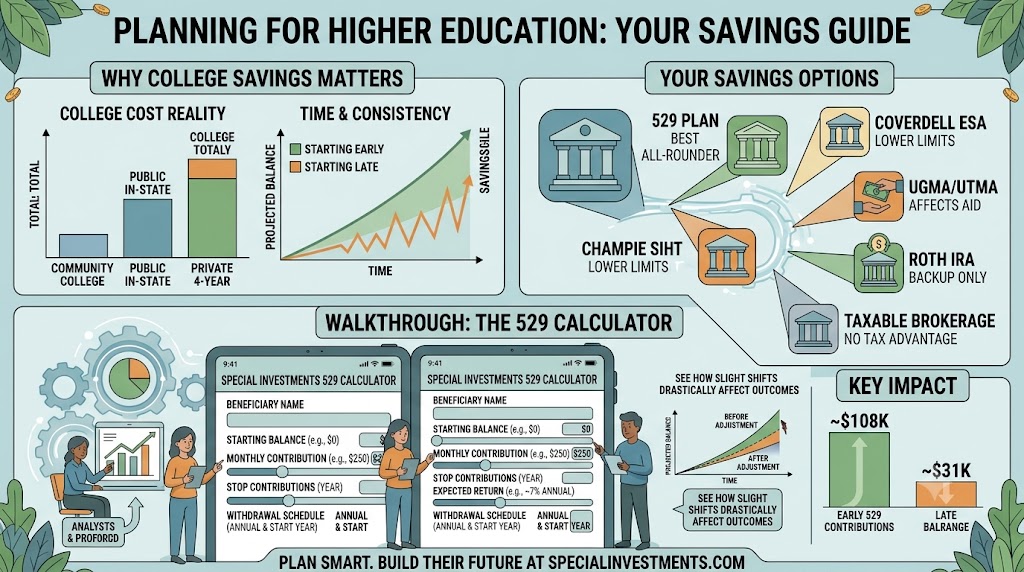
The average four-year degree can range widely: community college is often under $35,000 total, a public in-state four-year school might be roughly $110,000, while private colleges commonly exceed $260,000 (including room and board). These are large numbers, but they're manageable if you start early and let compound interest work for you.
Options for Saving
There are several ways families save for college; each has trade-offs:
- 529 Plans — Tax-advantaged, purpose-built education accounts. Contributions grow tax-free and qualified withdrawals are tax-free.
- Coverdell ESA — Tax-free for education but lower contribution limits and income limits apply.
- Custodial Accounts (UGMA/UTMA) — Flexible but funds become the child's at age of majority and can affect financial aid eligibility.
- Roth IRA — Contributions (not earnings) can be withdrawn penalty-free and can serve as a backup for education or retirement.
- Taxable Brokerage Account — No restrictions and full flexibility, but no tax advantages for education.
Why the 529 Plan Is Often the Best Choice
For most families, a 529 plan is the most efficient tool because of:
- Tax-free growth and tax-free qualified withdrawals.
- High contribution capacity and gift-tax-friendly rules.
- State tax deductions in many states.
- Flexibility to change beneficiaries or use funds for qualified trade schools, K–12 tuition (up to $10,000/year), apprenticeship programs, or student loan repayment (limits apply).
Walkthrough: Using the Special Investments 529 Calculator
Seeing the numbers for your own situation is the best way to make a plan. Our Special Investments page includes a 529 tab that lets you model growth, contributions, and withdrawals. Here's a step-by-step guide you can follow:
- Beneficiary & Starting Balance: Enter the child's name and any starting balance (or link a live account). If you're starting fresh, leave the balance at $0.
- Monthly Contribution: Enter what you can reasonably save each month. For example, $250/month is $3,000/year and is a common, manageable starting point.
- Stop Contributions: Choose when you expect to stop adding funds (for example, the year your child starts college).
- Expected Return: Set a projected annual return. A reasonable long-term estimate for an equity-heavy portfolio is ~7% annually; adjust if you use a more conservative mix.
- Withdrawal Schedule: Enter the annual amount you expect to withdraw for college (for example, $27,500/year for a public in-state school) and the year withdrawals begin.
- Review Results: The calculator will show projected balances, total contributions, and tax-free growth so you can see whether your plan hits your target.
Example: starting at birth with $250/month at a 7% annual return for 18 years gives a projected balance of roughly $108,000 when school starts. That result illustrates the power of compound interest — about $54,000 of your contributions could grow to roughly $108,000 in that span, and it's all tax-free when used for qualified education expenses.
What If You Want to Cover a Private School?
Private colleges can cost $60,000+ per year. At $250/month you won't hit that target; increasing contributions to around $600/month in the same example pushes the projection into the range needed to cover four years at many private schools. The calculator makes it easy to experiment with monthly amounts and expected returns so you can choose the path that fits your budget.
Starting Late: The Cost of Delay
If you wait until your child is 10 years old, for example, you only have ~8 years until college. With the same 7% return, $250/month over 8 years yields roughly $31,000 — far short of a typical four-year public-school bill. To reach the same $108,000 in 8 years would require saving closer to $900/month. The math is blunt: starting early makes the goal much more affordable.
Practical Tips
- Automate contributions: set up monthly transfers so you save without thinking about it.
- Start small and increase over time: even $50–$100/month compounds meaningfully over a decade or two.
- Use state tax deductions where available: many states offer deductions or credits for 529 contributions.
- Keep investment allocations age-appropriate: shift to more conservative investments as college approaches.
- Remember flexibility: unused 529 funds can be reassigned to family members or, in some cases, rolled to a Roth after long holding periods.
Conclusion: A Lasting Gift
Helping your child start their adult life without heavy school debt is one of the greatest gifts you can give. It's not about being wealthy; it's about time, consistency, and a smart use of tax-advantaged tools like a 529 plan. Use the Special Investments 529 calculator to model realistic scenarios for your family, and start today—your future self, and your child, will thank you.