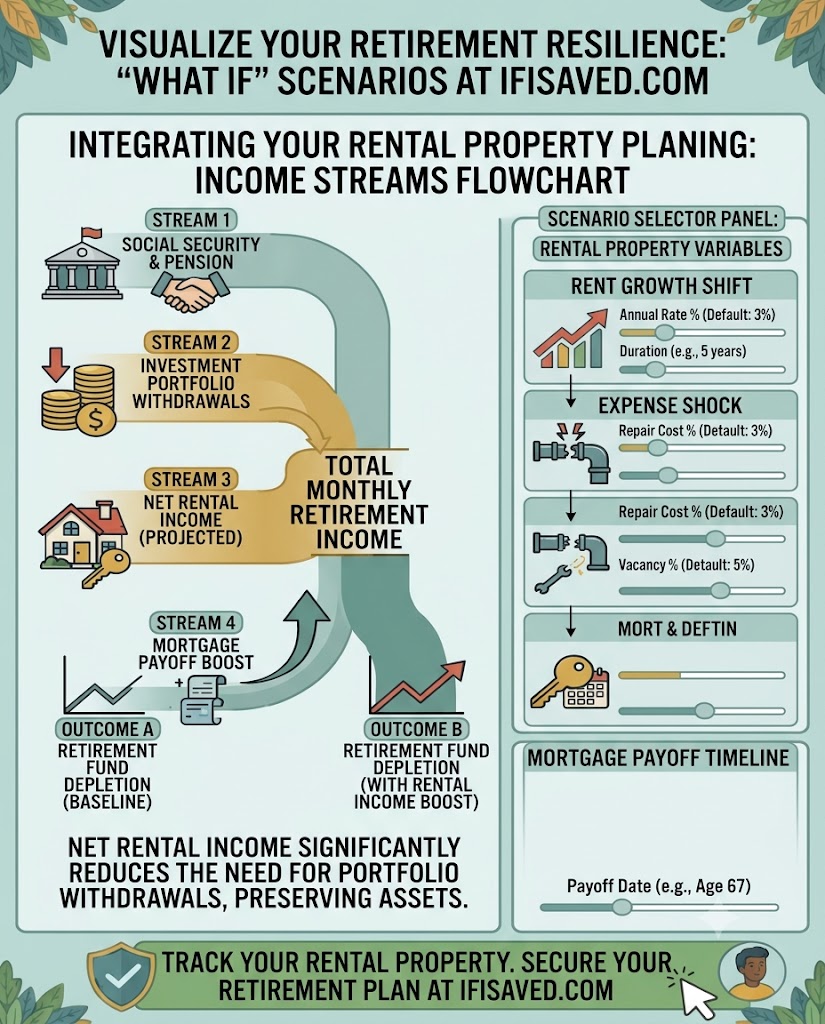
Owning a rental property is one of the most tangible ways people build wealth outside the stock market. The equity grows, the mortgage (hopefully) gets paid down by your tenant, and one day — if everything goes according to plan — the property throws off meaningful income every single month. But here is the reality most rental property owners face: they do not have a clear picture of how the property is actually performing right now, and they have not connected that performance to what their retirement will actually look like.
This is a gap worth closing. Not someday — now. Because the decisions you make about a rental property today, and the habits you build around tracking it, directly shape whether it becomes a retirement asset or a retirement liability.
The Problem with "It More or Less Covers Itself"
Ask most rental property owners how the property is doing and they will say something like: "It covers the mortgage, so I'm happy." That is a reasonable starting point, but it is not a financial picture. It leaves out property taxes, insurance, maintenance, repairs, vacancy months, property management fees, and the slow accumulation of capital expenditure — the roof that needs replacing, the HVAC system on borrowed time, the water heater quietly counting down.
When you add all of that up across a year, many properties that "cover the mortgage" are actually running at a thin margin or even a small loss. That is not automatically a problem — real estate investors often accept modest or negative cash flow in exchange for appreciation and equity growth. But it is information you need to have. Making decisions without it is like driving with a fogged windshield: you might be fine, or you might be about to drive into something.
The more important question is this: when do you expect the property to start generating consistent, positive cash flow? And when it does, how much will that income actually be — after expenses, not before them?
Why Monthly Expenses Matter More Than You Think
Expenses on a rental property are not uniform. Some are fixed and predictable — the mortgage payment, insurance premiums, property taxes. Others are variable and lumpy — a plumbing repair in February, a new appliance in June, a tenant turnover with two weeks of vacancy and a fresh coat of paint in October. The irregular ones are the ones that surprise people and the ones that matter most for planning.
When you track expenses at the transaction level — every repair, every maintenance cost, every management fee — you develop a real understanding of what this asset actually costs to own and operate. After a year or two of clean data, patterns emerge. You learn that vacancy and turnover costs average a certain amount per year. You learn that maintenance runs roughly a percentage of the property value annually. You can start to estimate what a realistic expense baseline looks like, rather than hoping this year will be the one where nothing breaks.
That baseline is the foundation for every financial projection that follows — including your retirement plan.
Tracking expenses at the transaction level also makes tax time substantially easier. Rental property expenses are deductible, and the ability to deduct depreciation, repairs, mortgage interest, and operating costs can meaningfully reduce your tax liability. But only if you have records. "I think I spent around $2,000 on repairs" is not a number your accountant can work with. A clean expense log is.
Connecting Your Rental Income to Your Retirement Plan
Here is where most property owners miss the bigger picture. Rental income is not just cash flow — it is a retirement income stream. And the quality of your retirement depends enormously on how much reliable, sustainable income you will have each month.
Think about the standard inputs in a retirement projection: Social Security benefits, a pension (if you have one), part-time work income, and withdrawals from investment accounts. For most people, those withdrawals from savings are the primary variable they are trying to manage — how much can I take out each year without running out of money?
Rental income changes that equation directly. Every dollar of reliable monthly rental income is a dollar you do not need to withdraw from your investment portfolio. If you are collecting $2,500 per month in net rental income in retirement, that is $30,000 per year your portfolio does not have to produce. At a 4% withdrawal rate, that is the equivalent of having an additional $750,000 in your investment accounts. The math is stark.
This is why rental income deserves to sit alongside Social Security and pension income in your retirement planning — not as a vague "and we have the rental properties" footnote, but as a specific monthly figure with a specific impact on your projected retirement security.
The key word is net. Gross rental income without subtracting operating expenses overstates what the property actually contributes to your retirement. If you collect $2,800 per month in rent but pay $600 in mortgage principal and interest, $250 in property taxes and insurance, $150 in management fees, and budget $200 for maintenance reserves, your net is closer to $1,600. That is still a powerful income stream — but the difference between $2,800 and $1,600 matters for planning purposes. Building your retirement projections on gross rent is how people end up surprised in year three of retirement when the numbers do not add up.
The Mortgage Payoff: A Retirement Income Inflection Point
One of the most powerful features of holding a rental property through to retirement is what happens when the mortgage is paid off. That $600 (or $1,200, or $1,800) monthly debt service disappears and becomes income instead. For many landlords, the mortgage payoff represents the single largest jump in their rental cash flow — sometimes turning a modestly cash-flowing property into a strong one almost overnight.
This creates a planning opportunity. If your mortgage payoff date aligns with (or slightly precedes) your target retirement date, you have a built-in income boost at exactly the moment you need it. If those dates do not align, you can evaluate whether making extra principal payments to accelerate the payoff makes sense, or whether redirecting that capital elsewhere produces better outcomes. Either way, you can only make that analysis if you know what the property's projected income looks like at different points in time.
Rental Expenses in Your Budget: The Connection Most People Miss
Many rental property owners pay for property expenses through the same accounts they use for everyday spending — a credit card, a checking account, a home equity line. Those transactions flow through their bank feeds and show up in their budget history, but they live in a no-man's land: they are not cleanly identified as rental expenses, which means they do not inform property-level profitability analysis, and they are not cleanly excluded from personal spending, which means they distort how much the household is actually spending on its own needs.
The fix is simple but requires intentionality: when you categorize a budget transaction, flag it as a rental property expense. That single data point lets you route it to the property's expense ledger, understand the true cost of operating the asset, and keep your personal budget clean. A $400 plumber bill at the rental is not household spending — it is a property operating cost. Treating it as such gives you two cleaner pictures: what the property actually costs to run, and what your household actually spends to live.
Over time, the property expense data that accumulates in your budget gives you the raw material for the income statement you actually need: rent collected minus itemized operating expenses equals net operating income. That is the number that matters for retirement planning, for tax preparation, and for making decisions about whether to keep, sell, or refinance the property.
What a Clean Rental Financial Picture Enables
When you have real data — actual rent collected by month, actual expenses by category, actual net operating income over time — a lot of decisions become clearer.
Should I raise the rent? If expenses have climbed and net income has compressed, the answer may be yes, even if it feels uncomfortable. Clean numbers make the case objectively.
Should I sell? If the property has appreciated significantly but net income is thin after accounting for all costs, and you are approaching retirement, it may make more sense to harvest the appreciation and redeploy it into income-producing assets or reduce your mortgage balance on your primary residence. Or the net income may be strong enough that holding is the obvious choice. You cannot make this call clearly without the data.
Can I retire on schedule? If rental income is a meaningful part of your retirement income projection, the accuracy of that projection depends on how accurately you have modeled the net income. A retirement planner that incorporates real rental income data — not estimates — gives you a much more reliable answer to this question than one that ignores it or guesses.
What is my true net worth? Property equity is a meaningful part of most real estate investors' net worth, but so is the income-producing value of the property as a going concern. A property generating $18,000 per year in net income has an investment value separate from and in addition to its equity. Tracking both dimensions gives you a fuller picture of what you have built.
Building the Habit Now
The investors who have the clearest picture of their rental properties at retirement are the ones who started tracking early — not because the early years are when it matters most, but because tracking is a habit, and habits compound just like money does. Two years of clean expense data is useful. Five years is significantly more useful. Ten years, showing the arc of costs over time and across market cycles, is genuinely powerful.
You do not need to be an accountant to do this well. You need to collect rent and note it. You need to log what you spend on the property and what you spend it on. You need a way to see those numbers in one place, separated from your personal finances but connected to your broader financial picture — especially your retirement plan.
Start with this month. Log the rent. Log the expenses. Connect the net income to your retirement projection. Do it again next month. In a year, you will have a real financial history of your investment property — and a retirement projection grounded in reality rather than optimism.
Tracking Your Rental Property on IfISaved
The Properties page on IfISaved now supports full income and expense tracking for investment properties. You can record your monthly rent collected, log itemized expenses — repairs, management fees, supplies, anything that hits the property — and see a live income statement showing rent income, total expenses, and net operating income for any month you choose. A print-ready statement is available for each period, useful for tax prep or just for your own records.
On the Budgets page, any transaction you categorize as Rental Expenses is automatically surfaced in its own Rental section, separate from your personal income and spending budgets. This keeps your household budget clean and routes rental costs to where they belong: the property's expense ledger.
On the Retirement Planning page, your total monthly rental income flows directly into the retirement income inputs, sitting alongside Social Security and pension income. It is factored into Monte Carlo projections, withdrawal calculations, and the net income your portfolio needs to produce each year. Change the rent figure on the Properties page and it updates your retirement picture automatically.
The goal is to make the connection between your rental property today and your retirement tomorrow as visible and concrete as possible — because that connection is real, it is significant, and it is worth understanding clearly.