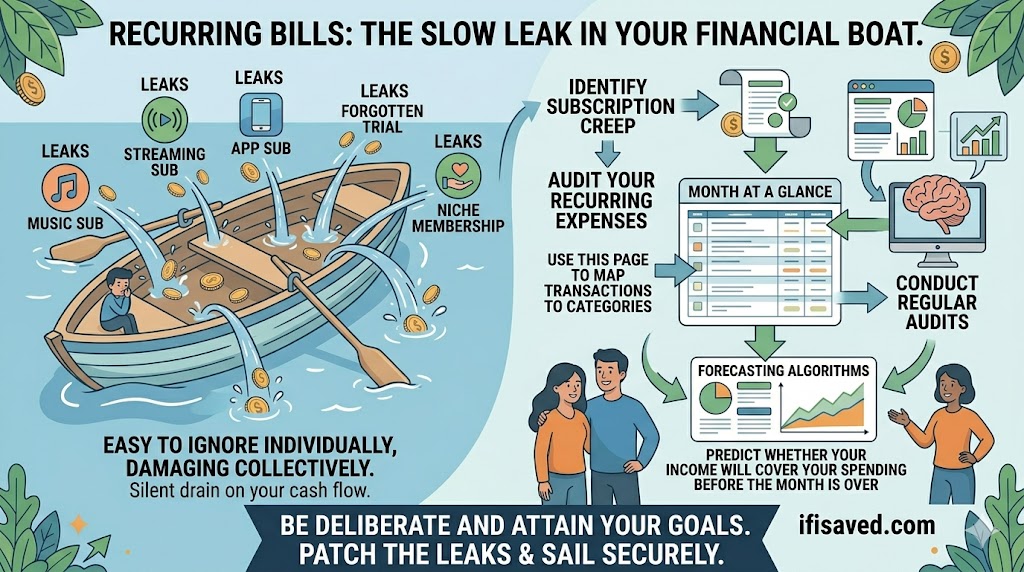
Every month, money leaves your account before you even think about it. A streaming service here, a gym membership there, a cloud storage plan you signed up for two years ago and completely forgot about. Individually, these charges look harmless. Together, they can quietly consume hundreds of dollars a month - money that could have been building your emergency fund, paying down debt, or growing in an investment account.
Recurring bills are the slow leak in your financial boat. Unlike a large one-time purchase that forces you to pay attention, a $14.99 charge barely registers. But multiply that by ten subscriptions and you are looking at $150 a month - $1,800 a year - slipping away on services you may barely use.
Why Recurring Bills Are So Dangerous to Your Budget
The psychology behind recurring charges is straightforward: they are designed to be forgettable. Subscription businesses thrive on what behavioral economists call passive consumption - you signed up with intention, but your engagement fades while the billing quietly continues. A 2022 study found that consumers underestimate their monthly subscription spending by an average of 2.5 times. Most people guess they spend around $80 a month on subscriptions; the actual average is closer to $200.
Beyond subscriptions, truly necessary recurring bills - utilities, insurance, phone plans, internet - also have a habit of creeping upward. Your phone plan adds a new fee. Your insurance premium renews at a higher rate. Your internet provider quietly bumps your bill after your promotional period expires. Without actively tracking these, you would never notice until the damage is already done to your monthly cash flow.
There are three categories of recurring expenses worth auditing regularly:
- Entertainment and streaming - Video, music, gaming, news, and podcast subscriptions. These tend to multiply fastest because they are inexpensive individually and easy to forget.
- Membership and access fees - Gyms, professional associations, software tools, cloud storage, and premium app tiers. Many were signed up during a free trial and never cancelled.
- Essential services with drift - Phone, internet, insurance, utilities. These feel fixed but actually drift upward over time, especially as promotional rates expire.
The Month at a Glance: Your Early Warning System
Spotting a subscription problem after the fact is one thing. Catching it before it throws your month off balance is far more powerful. That is exactly what the Month at a Glance page is designed to help you do.
The page analyzes your recent transaction history and automatically identifies your recurring expenses - the bills that show up month after month from the same merchant. Rather than forcing you to build a spreadsheet or remember every subscription you have ever signed up for, it surfaces them for you based on your actual spending patterns.
When you open Month at a Glance, you will see:
- Upcoming Recurring Expenses - Bills the system expects to hit before the end of the month, sorted by the day they are expected. If a charge you forgot about is in there, this is your chance to decide whether to cancel it before it auto-renews.
- The ability to tag and confirm - When a transaction is correctly identified as recurring, you can confirm it and fine-tune the expected amount and day. This makes future predictions more accurate and puts you in control of what the system is tracking.
- The ability to remove - If something is showing up as recurring but should not be — a one-time charge that happened to repeat, or a service you have already cancelled - you can remove it from your predictions so it no longer affects your month-end calculations.
Think of it as a recurring bill audit that runs automatically every time you open the page. Instead of a once-a-year exercise where you comb through bank statements, you have a real-time view of what is actively billing you.
Is Your Income Keeping Up with Your Spending?
Knowing what you have spent so far this month is useful. Knowing what you are going to spend by the end of the month and whether your income will cover it - is transformative.
The Month at a Glance page gives you exactly this forward-looking view. It does not just show you what has come in and gone out; it combines that history with predictions about what is still coming:
- Predicted remaining expenses - The recurring bills still expected to hit before the month closes, based on your confirmed and auto-detected recurring payments.
- Expected paychecks - Your upcoming income, predicted based on your historical deposit patterns. If your employer pays on the 1st and 15th, the system knows to expect your next paycheck on that schedule.
- Surplus or shortfall projection - By comparing your projected total income against your total budgeted spending, the page tells you whether you are on track to end the month in the green - or whether you are heading for a shortfall.
This forward view changes how you make decisions mid-month. Instead of spending freely in the first two weeks and scrambling in the last week, you can see in real time whether a discretionary purchase today puts you at risk of running short before your next paycheck arrives.
A Practical Example
Imagine it is the 12th of the month. You have spent $900 so far. Your total monthly budget is $2,200. At first glance, you are well within budget - only 41% spent with more than half the month remaining.
But open Month at a Glance and a different picture emerges. You have $380 in confirmed recurring bills still expected before the 31st - rent utilities, a car insurance installment, and a few subscriptions. Your next paycheck is not until the 20th. Your projected end-of-month surplus is just $120 after all predicted income and expenses are accounted for.
That changes your calculus. The dinner out and the new running shoes you were considering start to look like risks rather than rewards. You choose the dinner and skip the shoes - not because you are being restrictive, but because you now have the information to make a genuinely informed choice.
That is the power of prediction: it turns reactive budgeting into proactive budgeting.
Taking Action on What You Find
Once you can see your recurring bills laid out clearly, the action steps are straightforward:
- Audit ruthlessly. For every recurring item you see, ask: am I actively using this? Does it deliver value equal to or greater than its cost? If the answer is no, cancel it before it renews again.
- Confirm your legitimate recurring bills. For the subscriptions and services you are keeping, tag them in Month at a Glance with the correct expected amount and day. This improves your predictions and helps the system flag unusual changes when a bill amount shifts unexpectedly.
- Watch for creep. When a confirmed recurring bill shows up in your transactions for more than expected, that is a signal to investigate. Price increases and fee additions are easy to miss - but not if your predictions are calibrated and your actuals are compared against them.
- Check your income timing. If your projected expenses outpace your expected income at certain points in the month, consider whether adjusting your payment dates - many billers allow this - could smooth out the cash flow timing.
Small Leaks Sink Ships
No single $9.99 subscription is going to derail your financial life. But the habit of allowing small, unexamined charges to accumulate month after month is the same habit that keeps people living paycheck to paycheck even as their income grows. The antidote is not deprivation - it is visibility.
When you can see exactly what is recurring, exactly what is coming, and exactly how your income is expected to stack up against your spending before the month ends, you stop being surprised by your bank balance. You start being in control of it.
The Month at a Glance page exists for exactly that purpose. Open it early in the month, review your upcoming bills, confirm what belongs and remove what does not, and let the predictions guide your spending decisions for the rest of the month. That one habit, practiced consistently, can make a meaningful difference in how much money you have left when the month is over - and how much financial stress you carry in the meantime.