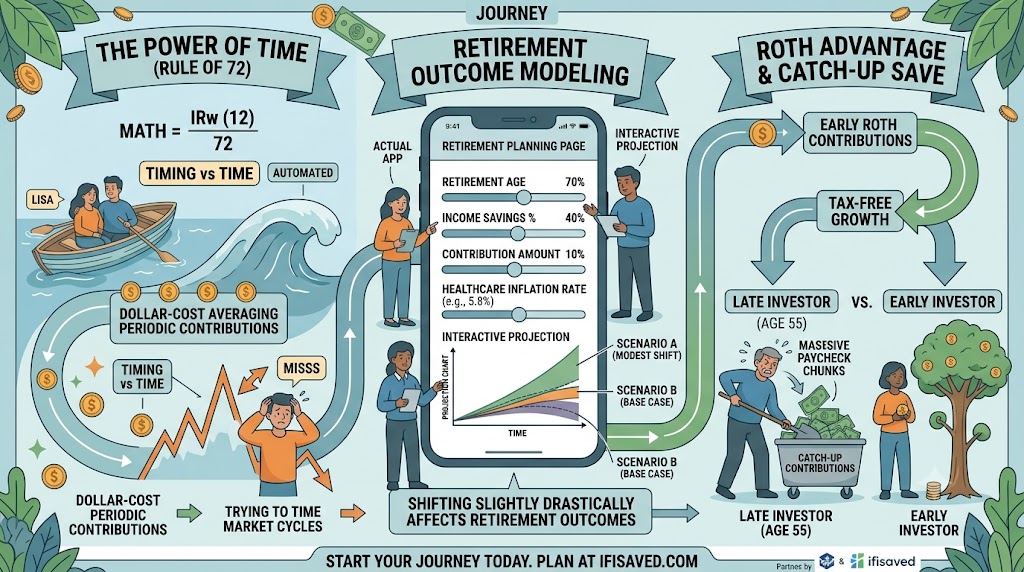
If there is one financial superpower available to young people, it is time. Not income. Not investment genius. Not luck. Just time. The earlier you start saving and investing, the less money you actually need to contribute to reach the same — or even better — retirement outcome. This is not motivational fluff: it is mathematical reality, driven by the exponential force of compound interest.
Understanding how compounding works, why staying invested beats trying to predict the market, and how small consistent contributions can grow into life-changing wealth is essential knowledge for anyone in their 20s and 30s. And if you are getting a later start, understanding these principles can help you adjust your strategy to catch up. Let's explore the concepts that can transform your financial future.
The Rule of 72: Your Mental Math Shortcut
The Rule of 72 is one of the most elegant tricks in personal finance. It lets you estimate how long it takes your money to double at a given rate of return. Simply divide 72 by your expected annual return percentage, and the result is the approximate number of years until your investment doubles.
Here is how it works in practice:
- At a 6% annual return, your money doubles every 12 years (72 ÷ 6 = 12).
- At a 7.2% annual return (close to the long-term average of the stock market), your money doubles every 10 years (72 ÷ 7.2 = 10).
- At a 9% annual return, your money doubles every 8 years (72 ÷ 9 = 8).
Now think about what this means if you start at age 25 with $10,000 invested at a 7.2% average annual return:
- Age 35: $20,000
- Age 45: $40,000
- Age 55: $80,000
- Age 65: $160,000
That single $10,000 investment at age 25 becomes $160,000 by retirement — without adding another dollar. Now imagine if you kept adding $5,000 or $10,000 every year. The compounding effect on regular contributions is staggering.
The Rule of 72 reveals why starting young is so powerful: every decade you wait costs you a doubling cycle. If you wait until 35 to invest that $10,000, you lose one doubling and end up with only $80,000 at 65 instead of $160,000. Ten years of delay costs you half your retirement balance. You can read more about the Rule of 72 at Investopedia and the SEC's investor education materials on compound interest.
Compound Interest: The Eighth Wonder of the World
Albert Einstein reportedly called compound interest "the eighth wonder of the world," adding: "He who understands it, earns it; he who doesn't, pays it." Whether or not he actually said it, the principle is undeniably true.
Compound interest means earning returns not just on your original investment (the principal), but also on the returns your investment has already generated. In the early years, this feels slow — almost invisible. But as your balance grows, the compounding accelerates dramatically. The gains start earning gains, and the growth curve bends upward.
Consider two investors:
- Investor A starts at age 25 and contributes $5,000 per year for 10 years, then stops completely. Total contributions: $50,000.
- Investor B waits until age 35 and contributes $5,000 per year for 30 years straight until retirement at 65. Total contributions: $150,000.
Assuming both earn a 7% average annual return, Investor A ends up with more money — even though they contributed one-third as much. Why? Because Investor A's money had 10 extra years to compound. Those early contributions grew for 40 years instead of 30. The math does not lie: time in the market beats late contributions every single time.
This is why starting in your 20s or early 30s is such a game-changer. You do not need to save massive amounts. You just need to start early and let compounding do the heavy lifting.
Time in the Market vs. Timing the Market
One of the most common mistakes new investors make is waiting for "the right time" to invest. They worry about buying at a market peak, or they wait for a correction, or they get paralyzed by headlines predicting a recession. This instinct to time the market — predicting when to buy low and sell high — feels smart, but decades of research show it is a losing strategy.
Here is the reality: even professional fund managers, with teams of analysts and sophisticated models, fail to consistently time the market. Study after study shows that time in the market beats timing the market almost every time.
Consider this: the stock market has historically returned an average of 10% per year (before inflation) over the long term. But those returns are not evenly distributed. Missing just the 10 best days in the market over a 20-year period can cut your total returns nearly in half. And those best days often happen right after the worst days — when fearful investors have already pulled out.
The takeaway: get your money into the market as early as possible and leave it there. Do not try to predict crashes or wait for dips. Invest consistently, ride out the volatility, and trust the long-term upward trend. History shows us that every major market downturn has eventually recovered — and investors who stayed in the market through downturns captured the full rebound.
Vanguard's research on market timing is summarized at Vanguard — Market Timing and Schwab has an excellent analysis at Schwab — Does Market Timing Work?.
Dollar-Cost Averaging: Smoothing Out Volatility
Dollar-cost averaging (DCA) is a simple strategy that makes investing less stressful and often more effective. Instead of investing a large lump sum all at once, you invest a fixed amount on a regular schedule — weekly, biweekly, or monthly — regardless of what the market is doing.
Here is why it works:
- You buy more shares when prices are low and fewer shares when prices are high. Over time, this averages out your cost per share and reduces the risk of investing all your money right before a market drop.
- It removes emotion from investing. You are not trying to guess the best entry point or panicking during a downturn. You just keep investing on schedule.
- It builds the habit of consistent saving. Automatic contributions — like those from a paycheck into a 401(k) — make saving effortless.
Dollar-cost averaging is especially powerful for young investors because it aligns with how most people earn and save: steadily, over time. You do not need a windfall or a big bonus to start. You just need to commit to regular contributions, no matter how small. Even $100 or $200 per month, invested consistently over decades, compounds into a substantial nest egg.
And here is a bonus: when the market dips and everyone else is panicking, your automatic contributions are buying shares at a discount. While others are selling in fear, you are accumulating wealth. Fidelity explains dollar-cost averaging in detail at Fidelity — Dollar-Cost Averaging.
Use the Retirement Planning Page to Model Your Future
Understanding these principles is one thing. Seeing them in action with your own numbers is another. That is where the Retirement Planning page on this site becomes an invaluable tool.
The Retirement Planning page lets you model different savings scenarios in real time. You can:
- Set the percentage of your income you plan to save each year. See how saving 10%, 15%, or even 20% of your income changes your retirement outcome.
- Allocate savings across different account types: traditional 401(k), Roth 401(k), Roth IRA, taxable brokerage accounts, and more. The calculator shows how different account types affect your tax situation in retirement.
- Adjust your expected rate of return, retirement age, and annual expenses. Play with the variables to see how small changes — like retiring two years later or increasing your savings rate by 2% — can have massive impacts on your financial security.
- Visualize the growth over time. Watch your contributions compound year after year. The charts make it clear how much of your final balance is growth versus contributions — and how that ratio changes depending on when you start.
Run the numbers for yourself. Input your current age, income, and savings rate. Then increase your savings rate by just 5% and see the difference at retirement. The results are often shocking — and motivating. A modest increase in your 20s or 30s can mean hundreds of thousands of dollars more in retirement, without sacrificing much in the present.
The Cost of Waiting: Catch-Up Contributions Are Not Enough
The IRS recognizes that many people do not save enough early in their careers, so starting at age 50, you are allowed to make catch-up contributions to retirement accounts. For 2026, that means an extra $7,500 per year to your 401(k) (on top of the standard $23,500 limit) and an extra $1,000 to your IRA (on top of the $7,000 limit).
These catch-up contributions can certainly help. But here is the hard truth: they cannot replicate the power of starting early.
Let's run the numbers. Suppose you start saving at age 25 and contribute $5,000 per year to a retirement account earning 7% annually. By age 55, you will have contributed $150,000 — and your account will be worth approximately $505,000.
Now suppose you wait until age 40 to start saving. To reach that same $505,000 by age 55, you would need to contribute about $20,000 per year — four times as much. Even with catch-up contributions starting at 50, hitting that target is extremely difficult. And if you wait until 50 to start? You would need to save nearly $35,000 per year for 15 years straight just to catch up to where the early saver ended up by contributing a fraction of that amount.
The message is clear: catch-up contributions are a helpful tool if you got a late start, but they are no substitute for the compounding power of time. The best "catch-up" strategy is to avoid needing one in the first place by starting early.
Small Sacrifices Today, Massive Rewards Tomorrow
One of the mental barriers young people face is thinking they cannot afford to save. Rent is high. Student loans are crushing. Salaries are low early in a career. The instinct is to wait until you are "making more money" to start investing.
But here is the reality: you will never feel like you have enough. There will always be another expense, another goal, another reason to delay. The key is to start now, even if it is small. Even $50 per month matters.
Think of it this way: skipping two dinners out per month could free up $100. That is $1,200 per year. Invested at 7% for 40 years, that $1,200 annual contribution becomes nearly $240,000. Two dinners a month, compounded over a lifetime, is a quarter of a million dollars. That is not deprivation. That is leverage.
The sacrifices you make in your 20s and 30s are temporary. But the compounding happens forever. Pay yourself first — set up automatic transfers to a Roth IRA or increase your 401(k) contribution by 1% — and let time do the rest.
Conclusion: Start Today, Not Tomorrow
The power of starting early is not a secret. It is not a hack. It is just math. Compound interest rewards patience and punishes delay. The Rule of 72 shows you how quickly money doubles. Time in the market beats timing the market. Dollar-cost averaging removes the guesswork and builds discipline. Roth accounts let young people lock in tax-free growth for life. And the Retirement Planning page on this site gives you the tools to see exactly how your choices today shape your future.
You do not need to be rich to start. You do not need to wait for the perfect moment. You just need to start — and keep going. Every year you wait costs you exponentially. Every dollar you invest in your 20s works harder than ten dollars invested in your 50s.
If you are young, you have something no amount of money can buy: time. Use it. Start saving today, even if it is just a little. Set up automatic contributions. Max out your Roth IRA. Increase your 401(k) by 1%. Run the numbers on the Retirement Planning page and see your future take shape.
The earlier you start, the less you have to save — and the more financial freedom you will have when it matters most. Do not let your future self wish you had started today.