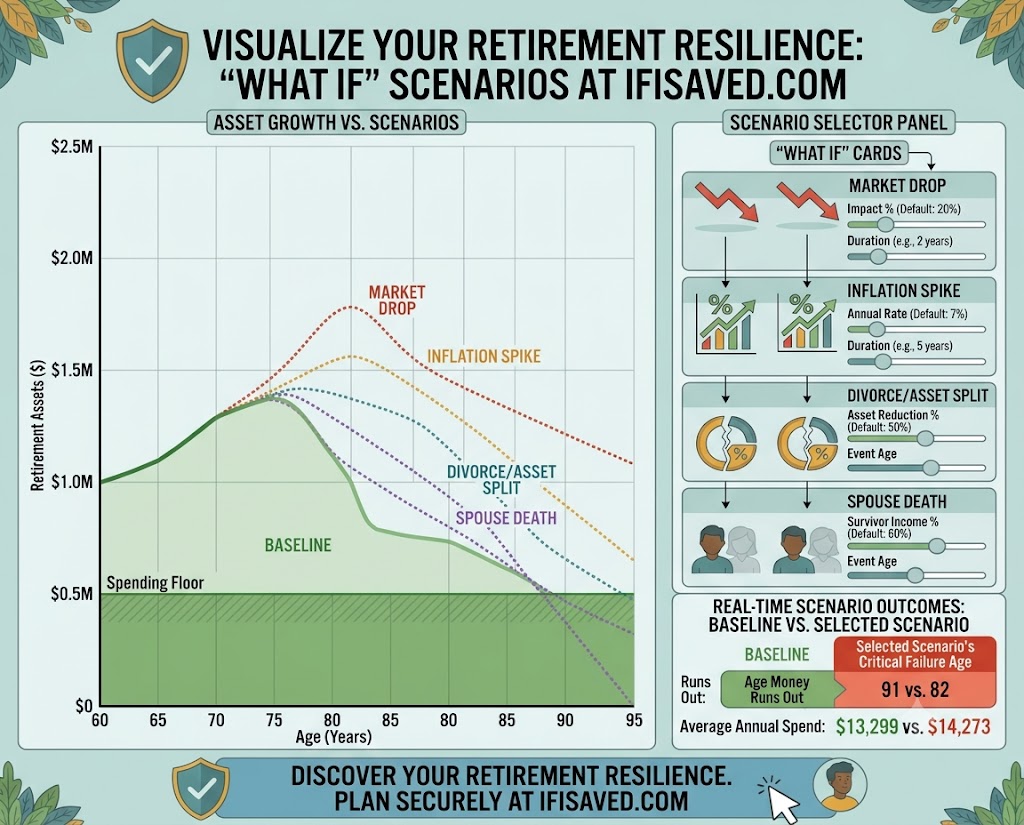
Even the most carefully built retirement plan assumes the future unfolds more or less as expected. But life rarely does. A market crash, a health crisis, the loss of a spouse, a divorce — any of these events can fundamentally change the financial landscape you retire into. The goal of retirement planning is not to predict exactly what will happen, but to understand which scenarios carry the most risk and build a plan resilient enough to survive them.
This post walks through five major life events that can seriously impact your retirement outcome, what the financial mechanics look like for each, and how to think about protecting yourself against them.
1. Divorce
Divorce is one of the most financially disruptive events that can happen to a retirement plan, particularly for couples who have built their savings together over many years. The financial impact operates on several fronts simultaneously.
Asset division is the most immediate blow. Depending on state law and the terms of your settlement, you could walk away with significantly less than half of the retirement accounts, home equity, and other investments you built together. A Qualified Domestic Relations Order (QDRO) is typically required to divide 401(k) and pension accounts without triggering early withdrawal penalties, but even a fair split means you are now funding a single retirement from what used to support two people in one household.
Loss of household income is the second major impact. If your spouse was also working, that income — and the savings contributions it was funding — disappears from your plan. You may go from two salaries contributing to retirement to one, often at a time when legal fees and the cost of establishing two separate households are straining your budget further.
Adjusted expenses add to the challenge. Many people underestimate how much it costs to run a household alone. Housing, utilities, insurance, and everyday costs that were shared now fall entirely on you. Your retirement spending plan likely needs to be revised upward, even as your ability to save has decreased.
From a Social Security perspective, divorce also matters. If you were married for at least 10 years, you may be entitled to a benefit based on your ex-spouse's earnings record — up to 50% of their full retirement benefit — without reducing what they receive. This can be a meaningful planning consideration, especially if one spouse significantly out-earned the other.
The most important thing you can do is run the numbers honestly after a divorce rather than assuming your old plan still holds. The path to a secure retirement may require working longer, saving more aggressively, adjusting your expected lifestyle, or some combination of all three.
2. Death of a Spouse
Losing a spouse is devastating in every dimension, and the financial consequences are often underestimated in retirement planning. The assumption that a surviving spouse simply continues on the same trajectory is almost always wrong.
Income loss during working years is the first area that often catches people off guard. If your spouse passes away while you are still working, their income — and all the retirement contributions it was funding — stops immediately. Depending on how your household budget was structured, this may make it significantly harder to continue saving at the same rate. Your expenses do not fall proportionally with a lost income, meaning a larger share of your remaining income must cover fixed costs, leaving less for retirement savings.
Reduced retirement income compounds the problem in retirement itself. A deceased spouse's pension typically pays out at a reduced rate to survivors (or nothing at all, depending on the option elected). Social Security survivor benefits are available — you can collect up to 100% of your deceased spouse's benefit if it is higher than your own — but this still represents a significant reduction from the combined household benefit you were planning on.
Expenses do not fall by half. This is one of the most commonly misunderstood aspects of planning for a spouse's death. Housing costs, utilities, insurance, and many everyday expenses remain nearly the same for one person as they were for two. Financial planners often suggest that a surviving spouse needs roughly 70–80% of the couple's previous income to maintain their standard of living.
Planning for this scenario while both spouses are healthy is far easier than responding to it in grief. Life insurance, spousal pension elections, survivor benefit Social Security strategies, and careful review of beneficiary designations are all tools that can meaningfully cushion this blow.
3. A Severe Market Drop
Markets have crashed before, and they will crash again. The question is not whether a major downturn will happen during your retirement, but whether your plan can survive one — particularly if it happens early in your retirement years.
This is known as sequence of returns risk, and it is one of the most underappreciated hazards in retirement planning. The order in which investment returns occur matters enormously when you are withdrawing money. A 30% market drop in year one of retirement forces you to sell more shares to cover your expenses than you would have needed to sell if the same drop happened in year ten. Those sold shares are gone — they cannot participate in the eventual recovery — which permanently shrinks your portfolio's ability to generate future income.
A portfolio that survives a crash early in retirement looks very different from one that experiences the same average returns but in a different sequence. Two retirees with identical savings and average returns can end up in completely different financial positions depending entirely on when the bad years hit.
How do you protect against this? The most commonly used strategy is maintaining a cash or near-cash buffer — typically 2–5 years of living expenses in cash, CDs, or high-yield savings accounts. During a market downturn, you draw from this liquid reserve instead of selling your investment accounts at depressed prices. This gives your portfolio time to recover without being forced to lock in losses.
Asset diversification across cash, bonds, and equities — calibrated to your risk tolerance — is the other primary tool. Bonds and cash equivalents tend not to fall as sharply in equity crashes, giving you sources of spending money that do not require selling beaten-down stocks.
4. Sustained High Inflation
Inflation is the quiet tax on retirement. Unlike a market crash, which is dramatic and visible, inflation erodes purchasing power slowly and steadily — until it does not feel slow anymore.
At 3% annual inflation, prices roughly double every 24 years. For someone retiring at 65 with a life expectancy into their 90s, this means the same lifestyle could cost nearly twice as much by the end of retirement as it does at the beginning. That is a significant planning challenge that many retirees discover too late.
The problem is most acute for retirees who rely heavily on fixed income sources — pensions, annuities, or conservative bond-heavy portfolios — that do not adjust with inflation. A pension paying $3,000 a month today pays the same $3,000 in nominal dollars 20 years from now, but that $3,000 might only have the purchasing power of $1,600 in today's dollars.
Periods of elevated inflation — like what much of the world experienced in 2021 and 2022 — are particularly dangerous in early retirement because they force higher withdrawals at a time when they can cause the most long-term damage. If you are spending 10% more than planned because groceries, healthcare, and housing costs have spiked, and your portfolio has simultaneously dropped because rising interest rates compressed bond values, you face a double squeeze that can permanently impair a retirement plan.
Maintaining meaningful equity exposure through retirement (not just before it), considering Treasury Inflation-Protected Securities (TIPS), and building in a flexible withdrawal strategy that accounts for higher-than-expected inflation are all useful defenses. Social Security does include an annual Cost of Living Adjustment (COLA), which is one of its most underappreciated features — another reason why delaying benefits to maximize your monthly amount can be a valuable long-term hedge.
5. A Major Medical Event
Healthcare is consistently one of the largest and most unpredictable expenses in retirement. Fidelity's annual estimate for a 65-year-old couple's healthcare costs in retirement regularly exceeds $300,000 — and that figure does not include the potential cost of long-term care.
A single significant medical event — a cancer diagnosis, a stroke, a major surgery — can generate out-of-pocket costs of tens of thousands of dollars in a short period, even with good insurance coverage. Deductibles, co-pays, out-of-network charges, and treatments not covered by Medicare can add up with stunning speed.
Long-term care is the largest wildcard. About 70% of people turning 65 today will need some form of long-term care in their lifetime, according to the U.S. Department of Health and Human Services. A year in a private nursing home room costs over $100,000 in many parts of the country. Home health aides can run $50,000 or more annually. Medicare covers almost none of this for extended care needs. Medicaid does, but only after you have spent down nearly all of your assets.
The financial impact goes beyond just the direct cost. A major health event often forces an early retirement — eliminating the working income and contributions you had planned on. It can shift a spouse into a caregiver role, reducing their income as well. And the emotional weight of managing a health crisis can make financial decisions harder precisely when they are most consequential.
Long-term care insurance, hybrid life insurance policies with long-term care riders, Health Savings Accounts (HSAs) built up during working years, and maintaining a healthcare expense reserve in your retirement plan are all tools worth exploring. The time to think about this is well before a health crisis arrives.
No Plan is Perfect — But Your Plan Can Be Resilient
None of these scenarios can be predicted with certainty, and you cannot build a plan that eliminates all risk. What you can do is understand which risks are most likely to affect you, quantify what the impact might look like, and make deliberate choices that improve your resilience.
The goal is not to plan for the worst and live in fear — it is to stress-test your plan against real scenarios so that if something goes wrong, you have options rather than panic.
That is exactly what the What If Scenarios tool on our Retirement Planning page is designed to help you do. You can model each of the five scenarios covered in this post — divorce, death of a spouse, a market crash, high inflation, and a major medical event — using your actual retirement inputs. Adjust the timing, the severity, and the assumptions to see how your specific plan holds up. The results are presented with the same Monte Carlo methodology used throughout the retirement planner, so you can see both the median outcome and the range of possible futures.
Head to the Retirement Planning page → What If Scenarios to run these scenarios against your own numbers and find out where your plan is strong — and where you might want to shore things up.