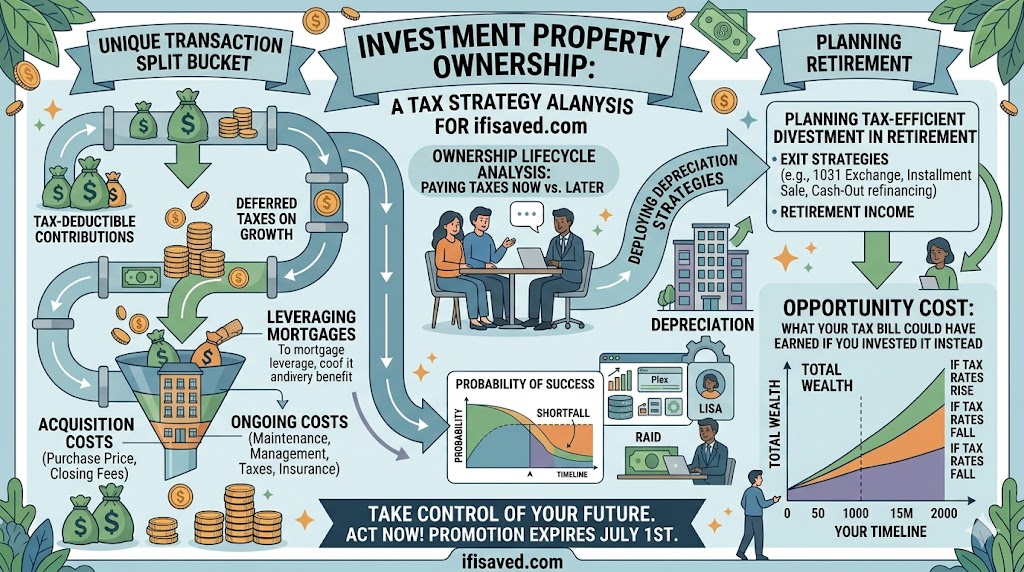
Real estate has long been one of the most reliable vehicles for building wealth. Investment properties offer a unique combination of cash flow, appreciation, tax advantages, and leverage that few other asset classes can match. But owning rental properties is not without its complexities — from understanding the true costs of ownership to deploying depreciation strategies, leveraging mortgages effectively, and eventually transitioning out of real estate as you enter retirement. In this article, we will walk through the full lifecycle of investment property ownership and the strategies that can help you maximize returns while minimizing your tax burden.
The True Costs of Owning Investment Property
Before purchasing a rental property, it is critical to understand the full picture of costs involved. Many new investors focus solely on the purchase price and expected rent, but the reality is far more nuanced. A thorough cost analysis is the foundation of any successful real estate investment.
Acquisition Costs
The upfront costs of acquiring an investment property extend well beyond the down payment. Closing costs typically run 2–5% of the purchase price and include lender fees, title insurance, appraisal fees, and attorney costs. Investment properties usually require a down payment of 20–25%, as most lenders will not offer the favorable terms available for primary residences. You may also need to budget for an inspection, any immediate repairs, and the cost of setting up property management if you do not plan to self-manage.
Ongoing Operating Expenses
Once you own the property, the recurring costs begin. These include property taxes, insurance (landlord policies are typically higher than homeowner policies), maintenance and repairs, property management fees (usually 8–12% of monthly rent), HOA fees if applicable, and utilities if not passed through to tenants. A good rule of thumb is to budget 1–2% of the property value annually for maintenance, and to set aside a capital expenditure reserve for large-ticket items like roofs, HVAC systems, and appliances.
Vacancy and Turnover Costs
No property stays rented 100% of the time. Budget for a vacancy rate of 5–10% depending on your market. Turnover costs — including cleaning, repairs, repainting, and marketing for new tenants — can quickly add up. Each turnover might cost $1,000–$5,000 or more depending on the condition of the unit and your local market.
Financing Costs
Investment property mortgage rates are typically 0.5–1.0% higher than primary residence rates. Over the life of the loan, this adds up substantially. Factor in the total interest paid over the loan term when evaluating the true cost of ownership. Refinancing can be a tool to optimize these costs, but it comes with its own closing costs and considerations.
Leveraging Mortgages to Build Your Portfolio
One of the most powerful aspects of real estate investing is the ability to use leverage — borrowing money to control a much larger asset. A 25% down payment on a $300,000 property means you are controlling a $300,000 asset with just $75,000 of your own capital. If the property appreciates 4% in a year, you have gained $12,000 on your $75,000 investment — a 16% return on your equity, before accounting for cash flow.
The BRRRR Strategy
The Buy, Rehab, Rent, Refinance, Repeat (BRRRR) strategy is a popular method for scaling a real estate portfolio. You purchase a property below market value, renovate it to increase its value, rent it out to stabilize income, then refinance based on the new appraised value to pull out most or all of your initial investment. The recovered capital can then be deployed into the next property. When executed well, this strategy allows you to grow your portfolio with a limited amount of initial capital.
Portfolio Loan Strategies
As your portfolio grows past four or more properties, conventional financing through Fannie Mae and Freddie Mac becomes more difficult. Portfolio lenders, commercial loans, and DSCR (Debt Service Coverage Ratio) loans become important tools. DSCR loans are particularly attractive because they qualify you based on the property's income rather than your personal income, allowing you to scale beyond what your W-2 or tax returns might support.
Using Equity Wisely
As properties appreciate and loan balances decrease, you build equity. Home equity lines of credit (HELOCs) on investment properties, cash-out refinancing, or cross-collateralization can unlock this equity to fund new acquisitions. The key is to maintain healthy debt-to-equity ratios and ensure that each new acquisition generates positive cash flow after accounting for all costs, including the new debt service.
Depreciation: The Real Estate Investor's Best Tax Tool
Depreciation is one of the most significant tax advantages of owning investment property. The IRS allows you to deduct the cost of the building (not the land) over a useful life of 27.5 years for residential rental property. This is a non-cash deduction — you are not spending money, but you are reducing your taxable income on paper.
How It Works
If you purchase a property for $300,000 and the building is valued at $240,000 (with $60,000 for land), you can deduct approximately $8,727 per year ($240,000 / 27.5) from your rental income. This deduction often offsets a significant portion of your rental profit, reducing or even eliminating your tax liability on that property's income.
Cost Segregation Studies
A cost segregation study is an engineering-based analysis that reclassifies components of a building into shorter depreciation categories. Items like flooring, cabinetry, appliances, landscaping, and certain fixtures can be depreciated over 5, 7, or 15 years instead of 27.5 years. This front-loads your depreciation deductions, providing substantially larger tax benefits in the early years of ownership. For properties valued at $500,000 or more, the cost of a segregation study (typically $5,000–$15,000) often pays for itself many times over in accelerated tax savings.
Bonus Depreciation
Under the Tax Cuts and Jobs Act, investors have been able to take bonus depreciation on the shorter-lived components identified in a cost segregation study. While the bonus depreciation percentage has been phasing down (80% in 2023, 60% in 2024, 40% in 2025, 20% in 2026), it remains a powerful tool for generating significant paper losses in the year of acquisition. These losses can offset rental income and, for qualifying real estate professionals, even offset W-2 or active business income.
Real Estate Professional Status (REPS)
For most taxpayers, rental losses from depreciation are classified as passive losses and can only offset passive income. However, if you or your spouse qualifies as a Real Estate Professional — spending more than 750 hours per year and more than half of your working time in real estate activities — those losses become non-passive and can offset any type of income. This is an incredibly powerful strategy for couples where one spouse manages the rental portfolio while the other earns W-2 income. The depreciation deductions can shelter the household's active income from taxation.
Real Estate in Retirement: A Steady Income Stream
As you approach and enter retirement, investment properties can serve as a reliable source of income that complements Social Security, pensions, and withdrawals from retirement accounts. A well-maintained portfolio of paid-off rental properties generates consistent cash flow with built-in inflation protection, since rents typically rise over time.
Transitioning from Growth to Income
During your accumulation years, leveraging properties with mortgages makes sense because you are maximizing returns on equity and building the portfolio. As retirement nears, the focus should shift from growth to stability and income. Paying off mortgages on your best-performing properties reduces risk and increases monthly cash flow. Consider entering retirement with some or all properties free and clear so that your rental income covers your living expenses without the drag of debt service.
Reducing Management Burden
The hands-on nature of property management can become burdensome in retirement. Transitioning to professional property management, consolidating into fewer but higher-quality properties, or moving into less management-intensive property types (such as net-lease commercial properties) can reduce the day-to-day workload while preserving income.
Sequence of Withdrawal Planning
Rental income can play a strategic role in your withdrawal sequence. Because depreciation shelters much of the income from taxation, rental cash flow may be more tax-efficient than withdrawals from traditional retirement accounts. By drawing from rental income first and allowing tax-deferred accounts to continue growing, you can potentially reduce your lifetime tax burden and extend the longevity of your retirement portfolio.
Divestment Strategies: Exiting Real Estate Ownership
There comes a time when many investors decide to reduce or eliminate their real estate holdings — whether due to age, health, desire for simplification, or a strategic rebalancing of assets. The challenge is that selling investment property triggers significant tax consequences, particularly depreciation recapture. Thoughtful planning is essential to minimize the tax burden of exiting.
Understanding the Tax Implications of Selling
When you sell an investment property, you face two layers of taxation. First, any profit above your adjusted cost basis is taxed as a capital gain — at the favorable long-term capital gains rate of 0%, 15%, or 20% depending on your income. Second, all depreciation you have claimed over the years is "recaptured" and taxed at a rate of up to 25%. This depreciation recapture can be a substantial and often surprising tax bill. For example, if you claimed $100,000 in depreciation over your ownership period, you could owe up to $25,000 in recapture tax alone, in addition to capital gains tax on the appreciation.
1031 Exchange
The most well-known strategy for deferring taxes on the sale of investment property is the Section 1031 like-kind exchange. By selling one investment property and purchasing another of equal or greater value within specific timeframes (45 days to identify, 180 days to close), you can defer both capital gains tax and depreciation recapture indefinitely. Many investors use 1031 exchanges throughout their careers to continuously trade up into larger or better-performing properties without ever paying tax on the gains.
1031 Exchange into a DST
For investors who want to exit active management but still defer taxes, a Delaware Statutory Trust (DST) is an excellent option. A DST qualifies as replacement property in a 1031 exchange, allowing you to sell your rental properties and invest the proceeds into a professionally managed, institutional-grade real estate portfolio. You receive passive income distributions without any management responsibilities. This is particularly appealing for retirees who want the tax deferral of a 1031 exchange without the burden of finding and managing a new property.
Installment Sales
An installment sale, also known as seller financing, allows you to spread the gain from a property sale over multiple years. Instead of receiving the full sale price at closing, the buyer pays you over time. This spreads your capital gains and depreciation recapture tax over the installment period, potentially keeping you in a lower tax bracket each year. This strategy works well when you want to exit a property but do not need all the proceeds immediately.
Opportunity Zones
If you have significant capital gains from a property sale, investing the gains into a Qualified Opportunity Zone Fund can provide tax benefits. You can defer the original capital gain until 2026 (or when you sell the opportunity zone investment), and if you hold the opportunity zone investment for at least 10 years, any appreciation on that investment is tax-free. This strategy works best for investors who are willing to redeploy capital into developing areas.
Charitable Strategies
Donating appreciated investment property to a charitable remainder trust (CRT) can be a powerful tax mitigation strategy. The CRT sells the property tax-free, invests the proceeds, and pays you an income stream for life or a set term. You receive a partial charitable deduction in the year of the donation, avoid capital gains tax on the sale, and generate retirement income. When the trust term ends, the remaining assets go to the charity. For charitably inclined investors, this is one of the most tax-efficient exit strategies available.
The Step-Up in Basis at Death
If passing property to heirs is part of your plan, the step-up in cost basis at death is one of the most powerful provisions in the tax code. When you pass away, your heirs inherit the property at its current fair market value — not your original purchase price. All accumulated depreciation recapture and capital gains are effectively erased. For investors with a large portfolio and a desire to leave a legacy, holding properties until death can be the most tax-efficient strategy of all. Proper estate planning, including the use of trusts, can ensure that properties transfer smoothly and that estate tax implications are managed.
Putting It All Together
Investment properties offer a remarkable combination of cash flow, appreciation, leverage, and tax benefits that can accelerate your path to financial independence and provide reliable income in retirement. The key is to approach real estate with a lifecycle mindset.
- In your accumulation years, use leverage and depreciation aggressively to build your portfolio and shelter income from taxes.
- As you approach retirement, shift focus to paying down debt, optimizing cash flow, and reducing management complexity.
- In retirement, use rental income as a tax-efficient income stream alongside your other retirement assets.
- When divesting, deploy strategies like 1031 exchanges, DSTs, installment sales, charitable trusts, or the step-up in basis to minimize the tax consequences of exiting.
Real estate investing is not a set-it-and-forget-it endeavor. It requires ongoing education, strategic planning, and adaptation to changing tax laws and market conditions. Working with a qualified CPA, financial planner, and real estate attorney throughout the journey will help you make informed decisions and keep more of what you earn. The wealth-building potential of investment properties is substantial — but it is the investors who plan their exit as carefully as their entry who ultimately capture the full value of their real estate portfolio.