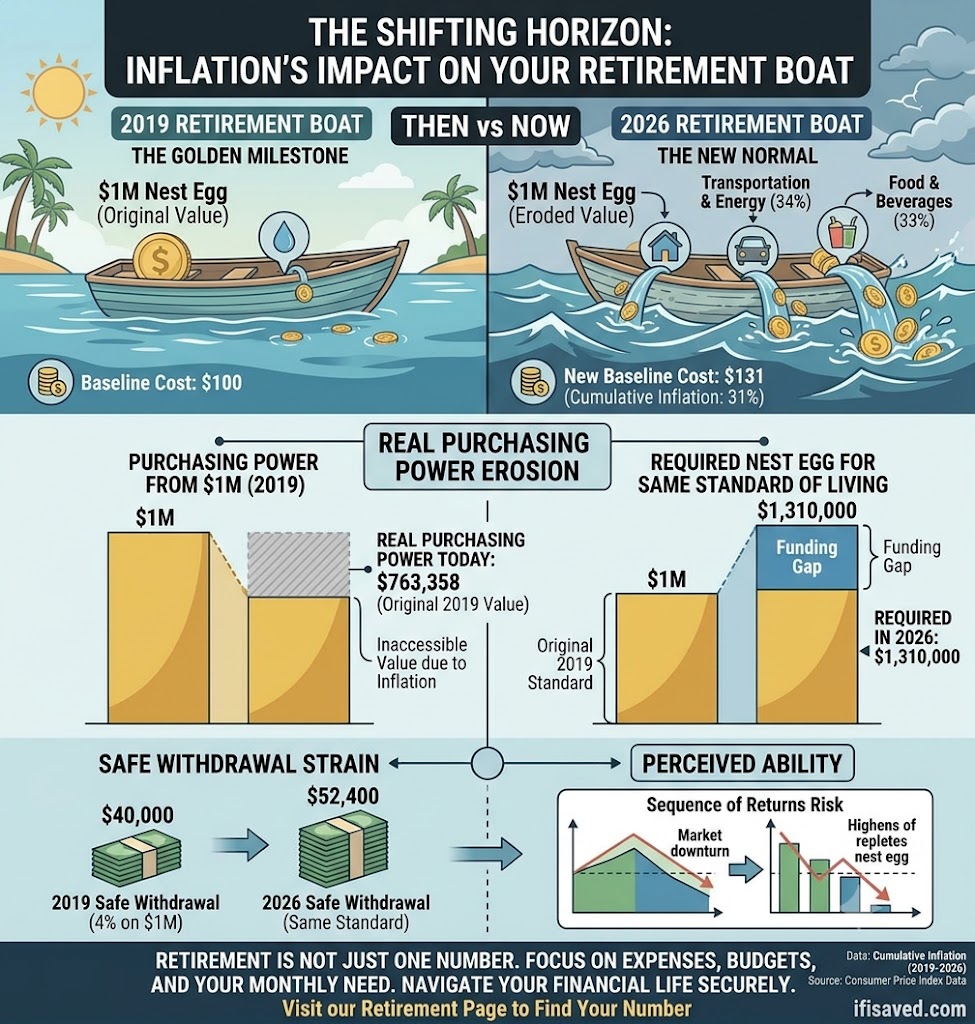
Here is a breakdown of how household costs have shifted and what that means for a $1M retirement nest egg.
1. Household Cost Impacts
According to consumer price index data, cumulative inflation between 2019 and 2026 sits at approximately 31%. This means a basket of everyday goods that cost $100 in 2019 now runs about $131.
The biggest drivers punishing modern household budgets are concentrated in fixed necessities:
- Housing & Shelter: Up roughly 33.6% over this period, pushing average rents and home prices to historic highs. This may not be a big factor for those close to retirement that already have equity built up in a home, but for younger people the idea of a 1M retirement nest egg is definitely impacted.
- Transportation & Energy: Up over 34%, driven by volatile global supply chains and rising fuel costs.
- Food and Beverages: Grocery and dining costs have surged by more than 33% cumulatively.
Because these price hikes target the baseline cost of living, households are feeling a massive "perceived inflation" wedge—meaning it feels even worse than headline statistics suggest because discretionary spending has had to contract.
2. The Impact on a $1M Retirement Nest Egg
Historically, a $1,000,000 nest egg was considered the golden milestone for a comfortable retirement. Today, the perception of that milestone has completely transformed.
The Purchasing Power Erosion
If you built a $1,000,000 retirement fund in 2019 and left it in cash or low-yield vehicles that didn't beat inflation, its purchasing power has been heavily diluted:
- Real Purchasing Power: Your $1M nest egg today only buys what $763,358 would have bought you in 2019.
- The Funding Gap: To achieve the exact same standard of living that $1,000,000 provided in 2019, you now need roughly $1,310,000 in 2026.
The Safe Withdrawal Strain
Most retirement plans rely on the traditional "4% rule" for sustainable withdrawals.
- In 2019, a 4% withdrawal on $1M yielded $40,000 in first-year retirement income.
- To get that same $40,000 worth of lifestyle security today, you have to withdraw roughly $52,400 in your first year.
Pulling a higher nominal amount early in retirement increases your "sequence of returns risk"—meaning if the stock market experiences a downturn while you are drawing down larger amounts to keep up with cost-of-living hikes, you risk depleting your nest egg significantly faster.
3. Shift in "Perceived Ability" to Retire
The psychological impact of this inflation cycle is significant. Even if a retiree's portfolio grew alongside the market, the perception of safety has vanished for many. Seeing grocery bills double and insurance premiums spike leaves people feeling like the goalposts are constantly moving. A $1M milestone no longer represents ultimate financial freedom; rather, it's now viewed as a baseline minimum for a modest retirement.
Conclusion
The amount of money you have in your retirement account shouldn't be what drives your decision to retire. You really need to look at your expenses now, see how that turns into a monthly budget and then seen what you need in order to meet that monthly need. If you are looking for a number, you are looking at it from the wrong angle. Head over to the retirement page and find out the number you need in order to reach your goal and from there, find out when you can and should reach that goal. Take a look at your budgets and see how much you are spending to find where you need to be on that monthly need number. Retirement is more than just one or two numbers, it is a conglomeration of all of your financial life. Take charge and move the needle!