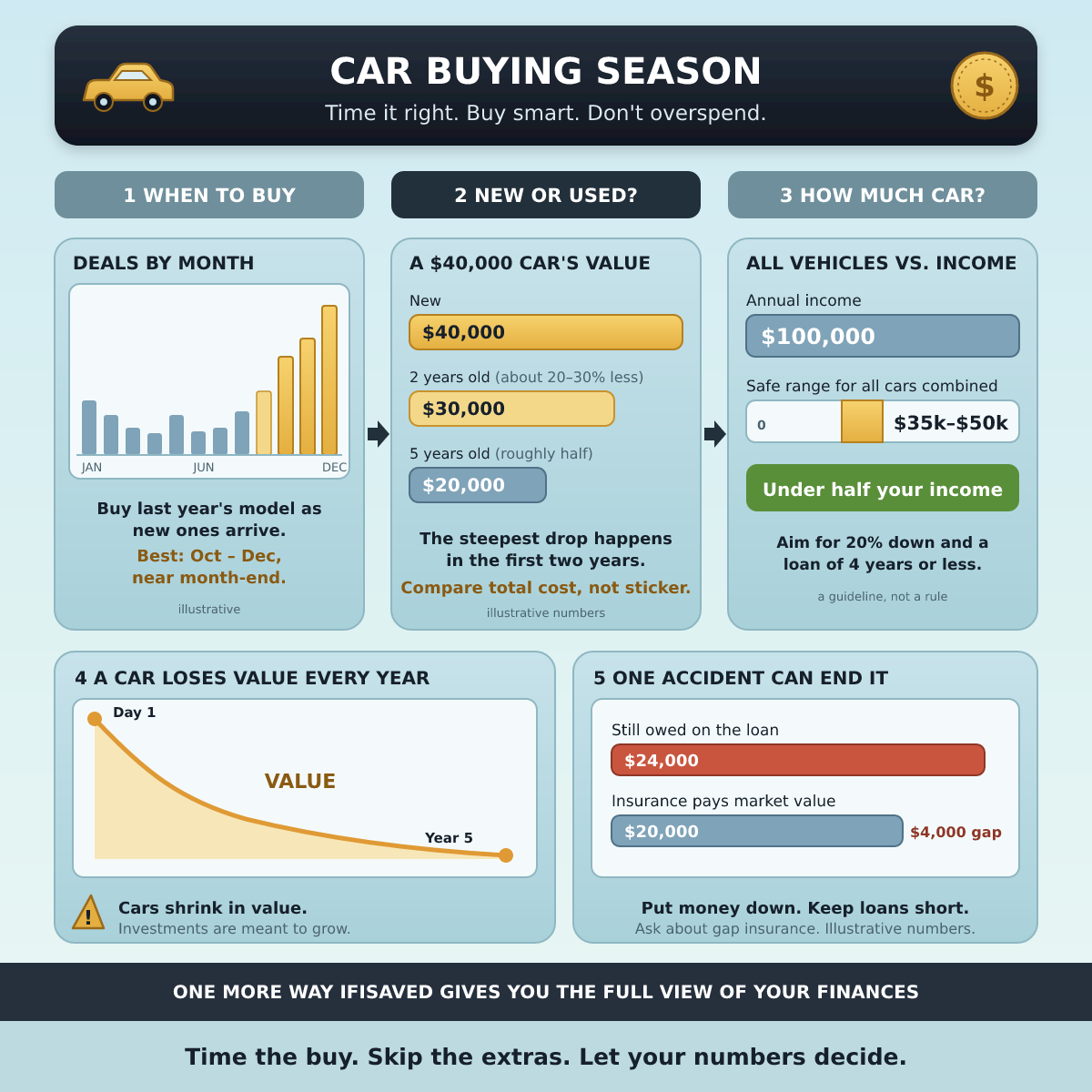
Fall is car buying season. New model-year vehicles are arriving on lots, last year's models are being marked down, and the year-end sales events are just around the corner. It is also the time of year when a lot of people make the second-largest purchase of their financial lives (after a home) with more emotion than math. Before you step into a dealership, here are four things worth knowing.
1. When Is the Best Time of Year to Buy?
There is no single magic day, but there are clearly better and worse times.
- When the new models arrive (late summer through fall): This is a good time to buy the outgoing model year, not the brand-new one. Dealers want to clear the previous year's inventory, and the car is essentially the same vehicle. A new-model-year car just introduced is usually at its highest price, with the least room to negotiate and the most demand from early adopters.
- The end of the month and quarter: Dealerships and salespeople work toward monthly and quarterly sales targets. A buyer who walks in during the last few days of a month will often find more flexibility than one who walks in on the second.
- The end of the year (November and December): This is historically the sweet spot. Dealers are chasing annual goals, manufacturers often add incentives, and the older model year is about to get a year older on paper. Holiday weekends tend to bring the biggest advertised incentives, though weather and holiday distraction keep showroom traffic low, which helps you.
- Winter for used cars: Used-car demand tends to dip in January and February and climb in the spring when tax refunds arrive. If you are shopping used, buying before the spring rush can help.
The takeaway: if you can be flexible, shop the outgoing model year in the fall and aim to close the deal near the end of a month, or in December. If you cannot wait, remember that the timing matters far less than the price you negotiate, the interest rate you get, and the car you choose. A great deal in March beats a mediocre deal in December.
2. Should You Buy New?
A new car loses value faster in its first few years than at any other time in its life. A common rule of thumb is that a new vehicle loses roughly 20% of its value in the first year and somewhere around 50-60% over five years, though it varies a lot by make, model, mileage, and condition.
That means a car that is two or three years old has already absorbed the steepest part of the drop. Typically, a two-year-old version of the same car costs noticeably less than the new one, often in the range of 20-30% less. On a $40,000 vehicle, that is $8,000 to $12,000 that stays in your pocket (or your investments).
The used-car math has gotten tighter in recent years. Since the supply disruptions of the early 2020s, used prices rose sharply and the gap between a nearly new used car and a new one narrowed. Higher interest rates on used-car loans also eat into the savings. So don't assume used is automatically cheaper. Do the comparison:
- Price the exact new model you want, including any manufacturer incentives or special financing.
- Price the same model at two and three years old with reasonable mileage, including certified pre-owned (CPO) options that come with a warranty.
- Compare the total cost, including the loan rate, the expected repair costs, and what the car will likely be worth when you plan to sell it.
Often the winner is a one- to three-year-old car, bought with a good rate, that still has some factory warranty left. Sometimes, when new-car incentives are strong, a new car comes close. Either way, the question is not "new or used?" but "what is the cheapest way for me to own a reliable car for the years I will actually keep it?" Cars you keep for ten years make the depreciation argument less important; cars you trade in every three years make it matter a lot.
3. How Much Car Is Too Much?
A useful guardrail is to compare the total value of all your vehicles to your annual income. A commonly cited guideline is that the combined value of your vehicles should not exceed about half of your annual gross income, and many conservative planners would push for 35% or less.
Here is what that looks like:
- Household income of $60,000: all vehicles together worth roughly $21,000 to $30,000.
- Household income of $100,000: roughly $35,000 to $50,000.
- Household income of $150,000: roughly $52,000 to $75,000.
This is a guideline, not a law, and it is easy to blow through it. Two financed SUVs can push a household well past it. But it is a good reality check, because every dollar sitting in a vehicle is a dollar not growing in your retirement accounts, paying down debt, or building your emergency fund.
A few related rules for the monthly side of things:
- Try to put at least 20% down so you aren't underwater on the loan the day you drive off the lot.
- Keep the loan term to four years (48 months) if you can, and avoid going past five.
- Keep your total transportation costs (payment, insurance, fuel, and maintenance) to roughly 10-15% of your gross monthly income.
If you are a long way over these numbers, don't panic, but do consider it when you pick your next car. Moving from a car that is too expensive to one that fits is one of the fastest ways to free up cash for investing.
4. Remember: A Car Is a Depreciating Asset
When we track net worth on IfISaved, it is tempting to count the car as an asset, and technically it is one. But it is a very different kind of asset from a home, a brokerage account, or a retirement account. Almost every vehicle loses value every year and, unlike investments, it does not generate income or grow over time. Your $35,000 car is worth less next year, and less again the year after that.
There is also a risk that most other assets don't share: a car can disappear in an instant. An accident, a flood, or a theft can turn your vehicle into a total loss overnight. Insurance generally pays the car's current market value, not what you paid and not what you still owe. If you owe more on the loan than the car is worth, you could be left paying off a car you no longer have. That is what gap insurance is for, and it is another reason to put money down and keep loan terms short.
So the next time you stand on a dealer's lot, ask yourself a simple question: how much of my net worth am I willing to put into something that is guaranteed to be worth less tomorrow than it is today? Buy a car that is reliable, safe, and affordable, time your purchase to take advantage of the calendar, and put the money you save to work somewhere it can grow. Your future self will thank you for it.